
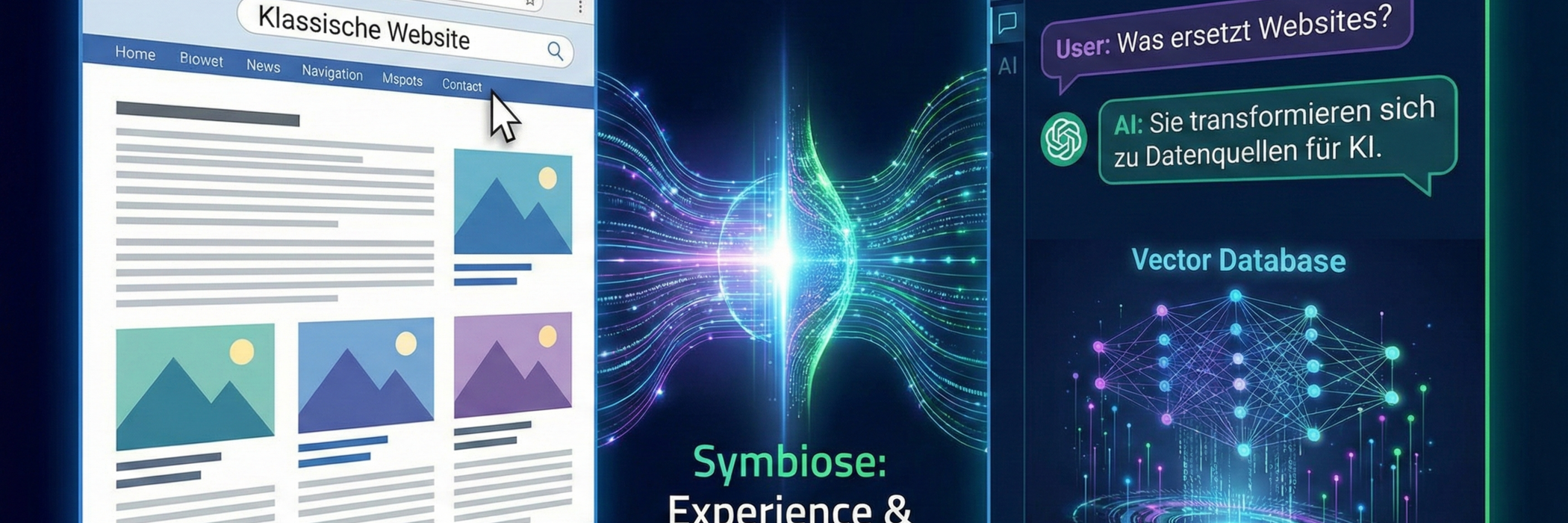
We're moving away from a world where we "surf" to a world where we "let". Here's an analysis of how chatbots, AI search and vector databases are changing the web:
1. the rise of "zero-click" search
A website used to be the destination. Today, it is often just the data store for an AI.
AI search (such as Perplexity or Google SGE): Instead of receiving a list of links, the user gets a directly formulated answer. The need to click on a website is reduced (zero-click).
Vector databases: They allow AIs to find information from millions of documents in a mathematical space at lightning speed. This means that the AI "understands" and extracts the content of a website without a human ever seeing the layout of the page.
2 Why websites (have to) stay anyway
Despite the efficiency of chatbots, there are three reasons why the classic website survives as a concept:
The source of truth: An AI does not produce new facts; it only aggregates them. Without websites that provide primary sources, journalistic content or product information, the AI would have no database (the so-called "incentive problem").
Transactions & trust: To buy a product, book a trip or enter into legally binding contracts, we need a secure environment. A website is the digital business card and the official salesroom of a brand.
Control over the experience: Companies don't want an AI to summarize their brand in a standard paragraph of text. They want to evoke emotions through design, video and interaction - a chat interface can only do this to a limited extent.
3. the transformation: from the "read web" to the "data web"
Websites will have to adapt technologically in order to remain visible in the AI world:
| Classic website | AI optimized website | |
|---|---|---|
| Main focus | Design for human eyes | Structured data for AIs & LLMs |
| navigation | Menus and clicks | Semantic search (vector search) |
| content | Long SEO texts | Modular information units (snippets) |
| Interaction | Static forms | Integrated chat assistants |
4. vector databases as new "backend heroes"
Vector databases (such as Chroma, Pinecone, Milvus or Weaviate) are the link. They enable companies to make their own websites "intelligent". Instead of a user laboriously scrolling through FAQs, the website feeds its data into a vector database. The user asks the website directly - and the website answers like an expert.
Conclusion: symbiosis instead of displacement
We are currently experiencing the slow replacement of the information website (sites that only provide superficial facts). These are being replaced by AI answers. What remains are experience websites and service websites. The website of the future is less a digital brochure and more an API interface that is perfectly readable for both humans (via a beautiful UI) and AIs (via structured vector data).
Would you like to know how to optimize an existing website specifically for AI crawlers or how a vector search is technically integrated into a page? Then get in touch with us.