
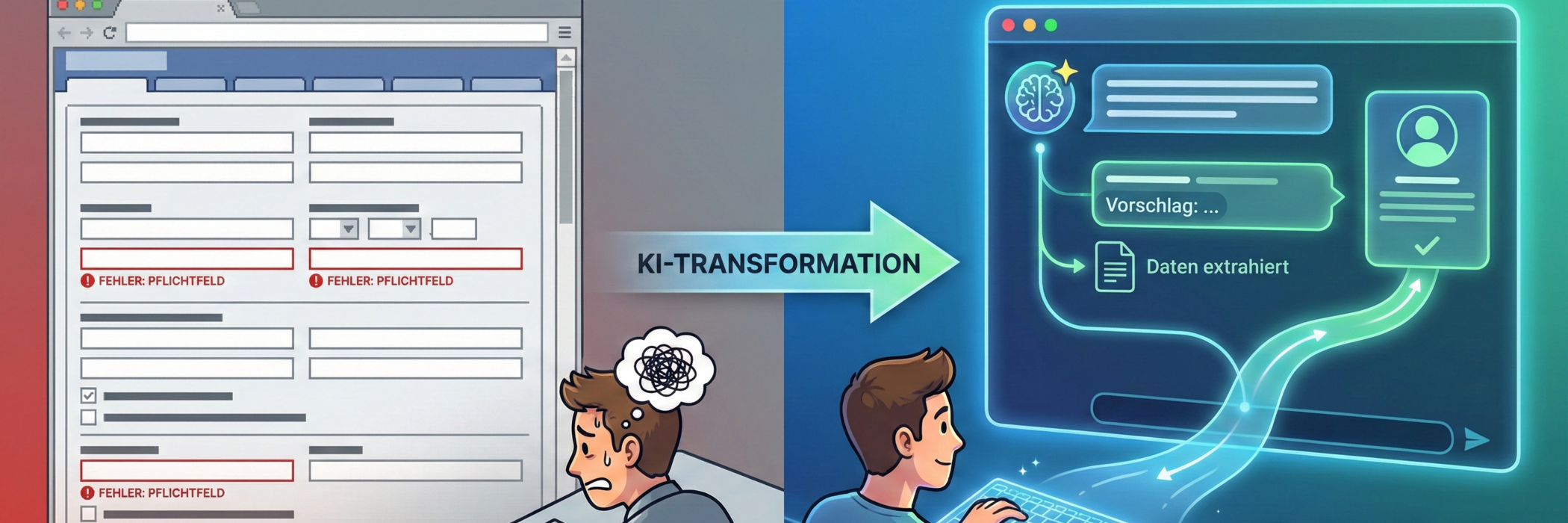
But we are in the year 2026 and the way we collect data has changed fundamentally. Artificial intelligence (AI) is transforming rigid input forms into dynamic, intuitive experiences.
What exactly are AI-supported forms?
In contrast to conventional forms that follow a fixed logic ("If A, then show B"), AI-supported forms use natural language processing (NLP) and machine learning to understand the context of user input in real time.
The core functions at a glance:
- Intelligent auto-completion: The AI anticipates what information will follow based on a few characters or previous behavior.
- Context-sensitive validation: Instead of displaying an error message ("Invalid format") when the form is sent, the AI corrects entries as they are typed or provides helpful hints.
- Conversational interfaces: Forms feel more like a chat than a visit to the authorities.
- Automated data extraction: users can upload documents (such as ID cards or invoices) and the AI automatically fills in the relevant fields.
Why companies should switch now
Switching from static to intelligent forms is not just a luxury, but a massive competitive advantage. Here's a comparison of the impact:
| Traditional forms | AI-powered forms | |
|---|---|---|
| Abandonment rate | High (due to complexity) | Low (due to personalization) |
| Data quality | Prone to errors due to manual input | High due to real-time validation |
| User experience | Frustrating and monotonous | Interactive and supportive |
| Processing time | Slow | Extremely fast (autofill focus) |
The greatest potential for practice
- Lead generation and sales
An intelligent form recognizes when a potential customer is a high-quality lead and adapts the questions immediately. It can offer specific case studies or directly suggest an appointment based on the user's answers. - HR and recruiting
Applicants no longer have to manually enter their entire CV into forms. An AI form extracts the data from the PDF and only asks specific questions about soft skills or motivation. - Customer support and ticketing
AI can display suggested solutions from the knowledge database as soon as a problem is reported. This reduces the number of tickets before they are even sent.
Important note: Despite all the automation, trust comes first. AI forms must handle data transparently and be GDPR-compliant (or in accordance with the current 2026 standards).
Conclusion: The end of the "form fright"
AI-supported forms are far more than just a technical upgrade. They are a sign of appreciation towards the user. By minimizing the barriers to data entry, we not only increase the conversion rate, but also collect more accurate data. The future of data collection is not a form - it's a conversation.