
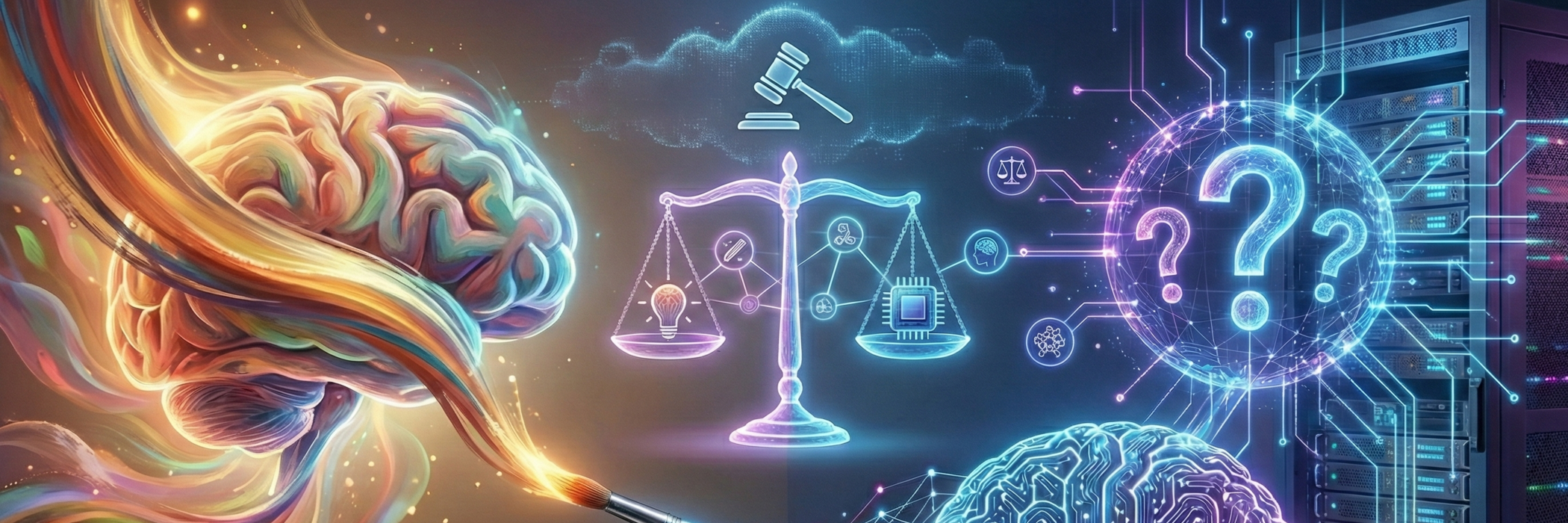
Here is an overview of the current legal situation (focus on Germany/EU and relevant US precedents).
1. the output side: who is the author?
According to the current state of German copyright law (UrhG) and the practice of the US Copyright Office, the short answer is usually: nobody.
The principle of human creation
Copyright law protects "personal intellectual creations". The human being as creator is central to this.
- The machine: An AI is not a legal entity and not a human being. It therefore cannot be an author.
- The user (prompter): This is where it gets complicated. Many experts argue that simply entering a text command (prompt) is not sufficient to establish authorship. The reason: the AI does the lion's share of the creative work (lighting, composition, line management). The user rather gives an "idea" or "order", and ideas alone cannot be protected by copyright.
Important: The prevailing opinion is that images that come "raw" from an AI generator are in the public domain. This means that anyone can copy and use them; you cannot prohibit others from using the same image.
The exception: The "human in the loop"
authorship can arise if the human massively reworks the AI image.
- Retouching & overpainting: If you heavily modify the image in Photoshop, paint over it or use it as part of a larger collage, you can obtain copyright in this editing.
- The tool argument: Some lawyers hope that AI will eventually be recognized as a mere "tool" like a camera. Currently, however, the prevailing view is that the randomness factor of AI is too great for it to be considered merely a tool.
2. the input side: training AI
This is the most ethically and legally controversial issue. AI models learn by analyzing billions of images from the internet - often without the consent of the artists.
Text and data mining (TDM)
- In the EU, there is a restriction in copyright law (Section 44b UrhG) that allows text and data mining for commercial purposes, provided the rights holder has not declared a reservation.
- Opt-out: Artists must actively object (e.g. by means of machine-readable notices) so that their works may not be used.
The point of contention: many artists were unaware of this training for years and had no technical means of opting out.
Ongoing lawsuits
In the USA (and partly in Europe), major class action lawsuits are underway (e.g. against Stability AI or Midjourney). Artists argue that AI models are sophisticated "collage machines" that plagiarize their style and works. The AI companies are invoking "fair use" in the US. The rulings in these lawsuits will be groundbreaking.
3. liability risks for users
Can I use AI images commercially without hesitation? Caution is advised here.
- Infringement of trademark rights: If you ask an AI to generate "Mickey Mouse in a dystopia", you are very likely infringing Disney's trademark and copyright by using this image.
- Imitation of protected characters: If a generated image resembles a real person (deepfake) or a protected character too closely, you as the publisher are liable - not the AI.
- Terms and conditions of the providers: Although tools such as Midjourney give paying users the commercial right of use according to their T&Cs, this does not protect them from legal action by third parties if the image happens to look too similar to an existing work.
4 Conclusion and outlook
We are in a legal gray area. Technology is developing faster than the law.
Summary of the current situation:
- No protection: pure AI images usually enjoy no copyright protection.
- Free use: You can usually use the images, but you do not have exclusive rights to them.
- Risk: Check AI images for similarities to well-known brands or people before publishing them.
What's next:
The EU AI Act (AI Regulation) will soon stipulate more transparency. AI models will have to disclose which data they were trained with. Work is also underway on watermarks that identify AI content as such.