
MCP: The “USB Standard” for Your Enterprise AI – Why Your Databases Are Finally Getting a Voice
Artificial intelligence (AI) is no longer a mystery today. Yet many companies face the same problem: their AI may be eloquent, but it knows nothing about what really matters – their internal data. Anyone who asks ChatGPT or Claude about the stock level of a product or the status of an offer often receives a friendly response: “I don’t have access to that.”
This is where the Model Context Protocol (MCP) comes into play. It is the technological bridge the industry has been waiting for.
What Is MCP, Really?
Imagine having to manufacture a custom, specialized charging cable for every electronic device you buy. That is exactly how AI integration has worked so far: every database and every tool required a tailor-made “special connection” to the AI.
MCP is the USB-C connector for the AI world. It is an open standard that enables language models (LLMs) to access data sources securely, quickly, and consistently. Instead of building complex, one-off integrations, we create a single “MCP server” for your company, and every modern AI immediately understands how to interact with it.
The Biggest Advantage: Your Databases Become “Queryable”
The true gold of your company lies in your existing SQL databases, ERP systems, or CRMs. Until now, making this data usable for AI without introducing security risks has been extremely complex.
Why MCP Is a Game Changer for Your Data:
- Real-Time Instead of Training: The AI does not need to be painstakingly “trained” on your data. Via MCP, the AI simply queries the database at the exact moment the user asks a question.
- Security & Control: We define precisely which tables the AI is allowed to see. The AI does not write database commands itself—it uses predefined, secure tools instead.
- Maintainability: If you change your database structure, there is no need to rebuild the entire AI logic. We only adapt the MCP server.
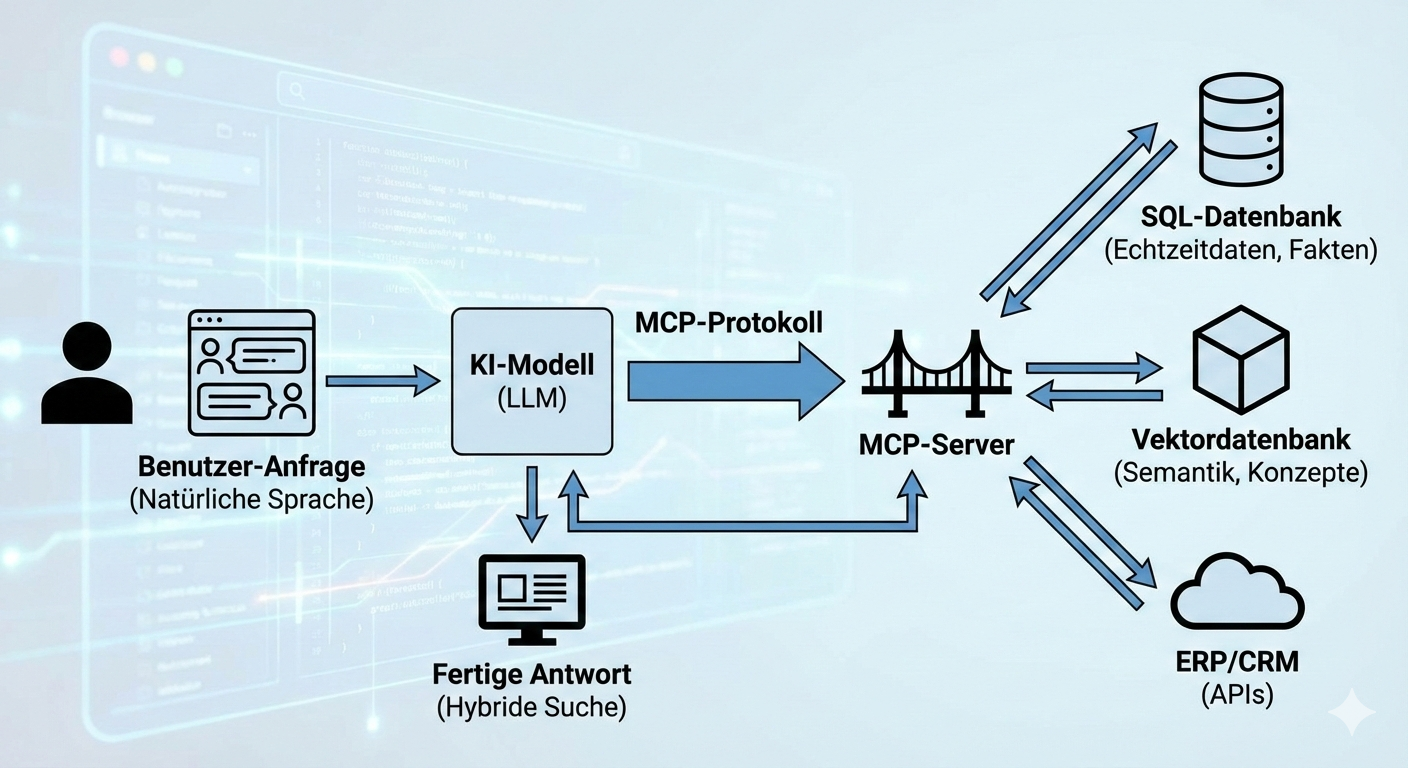
The Data Flow: How the Integration Works
To understand how MCP bridges the gap between users and data, it helps to look at the process. The AI acts as an intelligent intermediary, using the protocol to tap into multiple sources simultaneously.
Real-World Use Cases: Where MCP Makes the Difference
1. Intelligent Shops & E-Commerce
Instead of a simple search box, the shop becomes a consultant.
- The Use Case: A customer asks, “I need an outfit for a wedding in May that matches my last three purchases and can be delivered by Friday.”
- The MCP Advantage: Via MCP, the AI simultaneously checks the order history, the current inventory, and the delivery times in your ERP system.
2. Automated Quote Generation
Sales teams often spend hours gathering data from different systems.
- The Use Case: “Create a quote for customer XY based on last year’s conditions, but take the new price lists for 2026 into account.”
- The MCP Advantage: The AI accesses the CRM (customer data) and the SQL database (pricing) at the same time and drafts a complete document.
The Highlight: “Advanced Hybrid Search”
This is the supreme discipline. Normally, we face a dilemma: a classic database search is precise but “dumb,” while a pure AI search is intelligent but often inaccurate when it comes to hard facts. With MCP, we combine the best of both worlds.
Use Case: Searching for Social Services
Imagine a citizen looking for support for a family member:
“I need a day-care facility for my father that is highly experienced with dementia, within a radius of 5 km, and currently has available spots.”
- Vector Search (Semantics): The AI analyzes the request “highly experienced with dementia.” It searches concepts and reports for specialized care—even without exact keyword matches.
- MCP Database Query (Hard Facts): At the same time, the AI queries your live database via MCP: a 5 km radius, status “available spots,” and the correct care insurance accreditation.
The Result: The user receives facilities that perfectly match in content AND are factually available.
Conclusion: Ready for the Agentic Era?
MCP is the foundation for AI agents that can actually work instead of just chatting. For you, this means faster project timelines, lower costs, and an AI that truly understands your data.
Shall we explore how to make your databases “AI-ready” using MCP? Let’s identify your potential in a short call.