
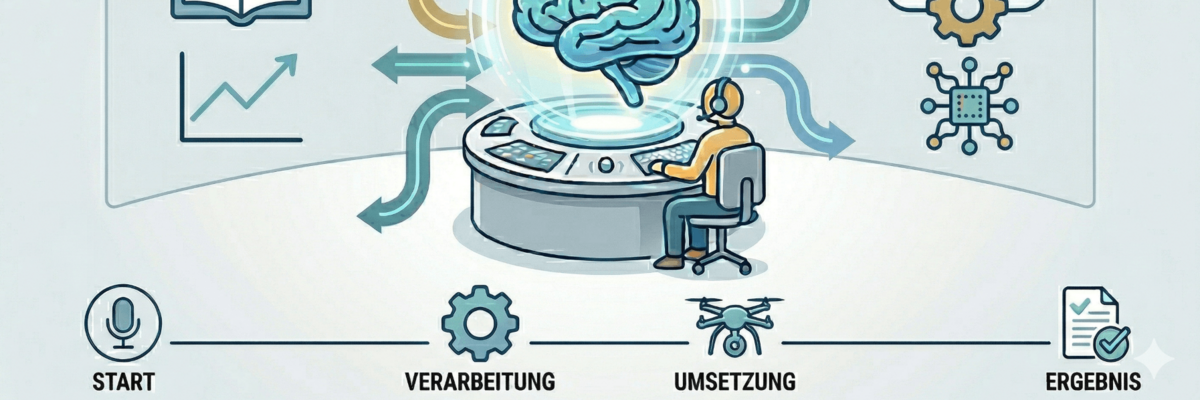
Today, the challenge lies in agentic orchestration: How do we coordinate an ensemble of specialized AI agents that autonomously plan tasks, use tools and exchange information with each other?
1 The anatomy of the agent backend
A backend that manages various agents must act as a central hub for identity, context and tools. We divide the architecture into three core components:
The Agent Registry (The Personnel Master)
Each agent is registered with a specific profile in the backend. This includes:
- Capabilities: Which tools (APIs, database access, code interpreters) does the agent have?
- Model mapping: Which LLM (e.g. GPT-5, Claude 4 or local special models) drives the agent?
- Constraints: What budgets ($tokens$, $time$, $costs$) are assigned to the agent?
The orchestrator (the flow engine)
This is the control center. It decides which agent is activated at which time. We primarily use two approaches here:
- Deterministic flows: A predefined graph (DAG - Directed Acyclic Graph) that maps strict process chains.
- Dynamic routing: A "manager agent" analyzes the problem and delegates tasks to the most suitable specialists at runtime.
2. modeling of communication flows
The biggest hurdle in agent collaboration is the consistency of knowledge. When agent A creates an analysis, agent B must understand what it is based on.
State Management & Shared Memory
An effective backend implements a multi-level memory hierarchy:
- Episodic memory: the current message history of the session.
- Semantic memory: A vector database (RAG) that provides relevant knowledge from past interactions.
- Shared workspace: A shared document or JSON object that all agents in a flow can work on.
Communication pattern
The choice of pattern determines the efficiency of the system:
| Pattern | Functionality | Ideal area of application |
|---|---|---|
| Sequential | Agent A hands over to Agent B (pipeline). | Standard reporting. |
| Hierarchical | One manager controls several sub-agents. | Complex software development. |
| Broadcast | All agents receive the same information at the same time. | Creative brainstorming. |
| Peer-to-peer | Agents call each other as required. | Ad-hoc problem solving. |
3. the "agent handover" problem
A critical moment is the handover. When an agent relinquishes control, the context must be transferred without loss. Today, we use structured protocols for this. A simple text transfer is not enough; we need metadata.
A typical transfer payload in the backend looks like this schematically:
JSON
{
"source_agent": "Market_Analyst_v4",
"target_agent": "Content_Writer",
"handoff_reason": "Data_Collection_Complete",
"context_snapshot": {
"key_metrics": [12.4, 45.1],
"confidence_level": 0.94
}
}
4 Operational excellence: monitoring and guard rails
Multi-agent systems can develop unpredictable dynamics of their own (e.g. "infinite loops" between two agents). A modern backend therefore requires:
- Cycle detection: algorithms that recognize when agents are going in circles without getting any closer to their goal.
- Human-in-the-loop (HITL): Interfaces that force a human release at critical decision points.
- Token guardrails: Automatic scheduling of flows if the cost limit for an individual task is exceeded.
Conclusion: the backend as conductor
Development is shifting away from writing business logic towards designing interaction logic. The backend of tomorrow is the conductor of an orchestra of specialized AIs. Those who master orchestration and the flow of communication will create systems that go far beyond the capabilities of isolated language models.