
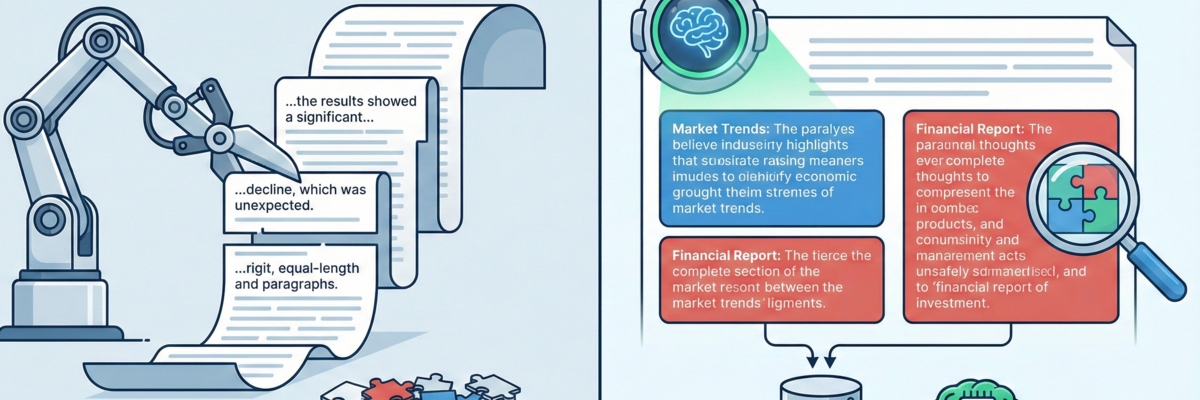
But one crucial success factor is often overlooked: The way we prepare our data. The bottleneck of many AI applications is not the model, but chunking - the breaking down of documents into processable chunks. This is where semantic chunking comes in and fundamentally changes how machines "understand" text even before they save it.
The problem: The "dumb" scissors (fixed-size chunking)
The traditional method of preparing documents for a vector database is fixed-size chunking. This involves stubbornly dividing a text according to a fixed number of characters or tokens (e.g. 500 tokens), often with a small overlap (window overlap).
The shortcoming:
This method is purely mechanical and ignores the content. A topic is often cut off in the middle of a sentence or argument.
- Chunk 1: "...the sales figures were positive, however, we had to adjust due to the"
- Chunk 2: "increased raw material prices caused us to adjust our profit."
If a user asks: "Why was the profit adjusted?", the vector search may find chunk 2, but the context ("sales figures") is missing. Chunk 1, on the other hand, contains the cause, but not the consequence. The semantic integrity is destroyed.
The solution: semantic chunking
Semantic chunking breaks with the rigid character limits. Instead, the algorithm analyzes the meaning of the text and identifies sections that belong together in terms of content. It only separates when the topic or context changes significantly.
The core idea: We use the intelligence of embeddings (vectors) during data preparation (ingestion), not just during the search.
How does it work technically?
The process can be divided into three phases:
1. sentence splitting (atomic units)
First, the document is broken down into its smallest semantic units: Sentences. This is usually done using NLP libraries that recognize punctuation marks and sentence structures.
2. vectorization & comparison (the "similarity check")
A temporary embedding is created for each sentence (or small groups of sentences). The algorithm then compares the vector of sentence A with the vector of sentence B (cosine similarity).
- Is the similarity high? -> The sentences deal with the same topic.
- Is the similarity low? -> There is probably a change of topic here.
3. grouping (the actual chunking)
The algorithm combines all consecutive sentences into one chunk as long as the semantic distance remains stable. As soon as the distance falls below the threshold value, the current chunk is closed and a new, thematically independent chunk is started.
A practical example
Imagine a PDF that first contains a technical manual and then seamlessly transitions into the warranty conditions.
- Fixed-size chunking: Would simply cut after 500 words. The last sentences of the technical manual and the first lines of the legal warranty conditions end up in the same vector. The AI could later hallucinate that technical specifications are part of the legal instructions.
- Semantic chunking: The algorithm recognizes the hard break in the vocabulary (from "screw/torque" to "liability/paragraph"). The similarity of the sentences crashes. The system makes a clean cut exactly between instructions and warranty.
Advantages and disadvantages in comparison:
| Feature | Fixed-size chunking | Semantic chunking |
|---|---|---|
| Speed: Very fast (CPU only) | Very fast (CPU only) | Slower (requires GPU/API calls for embeddings) |
| Costs | Almost free of charge | Higher (due to embedding calculation per record) |
| Context quality | Random | High (topic-based) |
| Retrieval precision | Medium | Very high |
When is semantic chunking indispensable?
Semantic chunking is particularly useful when:
- The documents are unstructured: Long continuous texts, transcripts of meetings or wikis in which topics flow smoothly into one another.
- High precision is required: If the AI has to answer complex questions ("reasoning") where the complete context of an argument must be available in a single chunk.
- Noise should be removed: Semantic chunking can help to isolate irrelevant elements (such as recurring headers, footers or disclaimers), as these often have no semantic similarity to the actual content.
Conclusion
Semantic chunking is the step from mechanical slicing to intelligent structuring of data. Although it increases the initial computing load during import, it pays off during operation with significantly more relevant search results and more precise AI responses. It is increasingly establishing itself as best practice for high-quality RAG pipelines.