
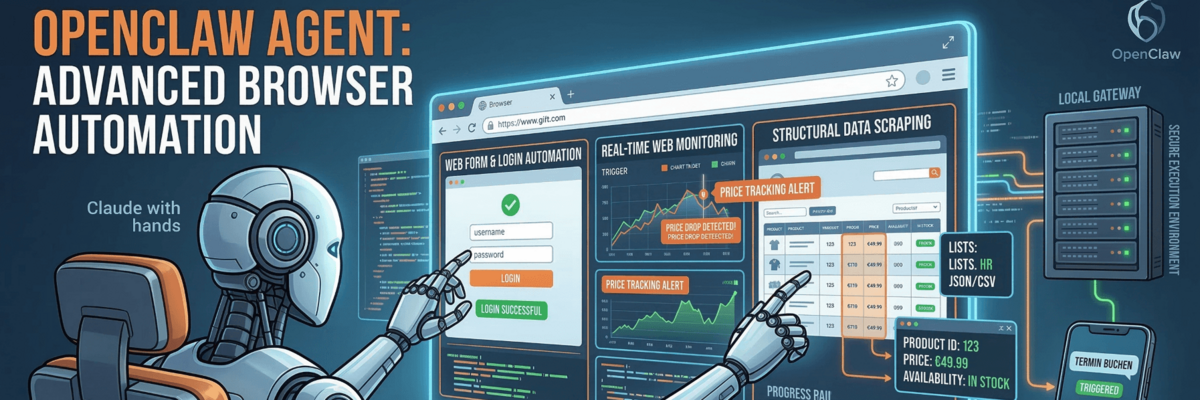
While classic chatbots such as ChatGPT act as the "brain in the cloud", OpenClaw acts as the central nervous system and the extremities on local hardware. It enables the AI not only to talk about tasks, but also to execute them autonomously in the file system, browser and shell.
1 The range of applications: Where AI does the work
OpenClaw breaks down the barrier between digital dialog and physical system interaction. The automation potential can be divided into four core areas:
| Domain | Concrete automation scenarios |
|---|---|
| Browser & Web | Automatic scraping of data without API, price monitoring, automated check-in for flights or login processes in legacy systems. |
| Developer workflows | Autonomous debugging of local codebases, monitoring of GitHub repos, automated deployment and documentation creation. |
| Enterprise & Orga | Email triage (sorting and drafting), appointment synchronization via messenger interface, automated creation of reports from various data sources. |
| Personal Productivity | Synchronization between Notion, Obsidian and local file systems; file conversions and intelligent clean-up of download folders. |
2. the technical mechanics: Hooks, Cron and Heartbeat
The superiority of OpenClaw over simple scripts lies in its proactive nature. Instead of waiting for a manual impulse, the system uses three central trigger mechanisms to ensure autonomy:
- A. Hooks (Event-Driven)
Hooks react to external events in real time. As soon as a webhook is triggered - for example by a new email or a message via Telegram - the agent "wakes up", analyzes the context and executes the corresponding action. - B. Cron (Time-Driven)
Classic time-controlled tasks are implemented by integrating cron jobs. This is ideal for repetitive tasks such as daily backups, morning news briefings or weekly system clean-ups. - C. Heartbeat (State-Driven)
The heartbeat is the unique selling point for real agent intelligence. The agent checks the system status or external parameters at fixed intervals. Based on the current situation, it decides independently whether there is a need for action (e.g. "The server load is too high, I'm shutting down non-critical processes").
3. modularity through skills and local sovereignty
The OpenClaw ecosystem is based on skills. A skill is an encapsulated module that combines a specific logic (Python or shell scripts) with a semantic description (SKILL.md). This description allows the LLM to understand the capabilities of the skill and to call them up as required.
A decisive advantage is the local execution (self-hosting). While logical processing can take place via APIs (such as Anthropic's Claude), the actual execution of the commands takes place in the user's protected environment. This ensures maximum control over sensitive data that never has to leave the local network.
4 Security and governance in the agent era
With great power comes system-critical responsibility. Since OpenClaw has direct access to the shell and file system, a security strategy is essential:
- Sandboxing: The use of Docker containers isolates the agent from the rest of the operating system.
- Principle of Least Privilege: The agent should operate under a user account with minimal rights.
- Human-in-the-loop: A confirmation loop via messenger can be integrated for critical actions (e.g. deleting files or financial transactions).
Conclusion: The future of local AI
OpenClaw transforms the PC from a passive tool into an active employee. The combination of event-driven logic and the flexibility of modern LLMs enables automation that was previously reserved for expensive enterprise solutions. For developers and power users, this means nothing less than liberation from routine digital work.