
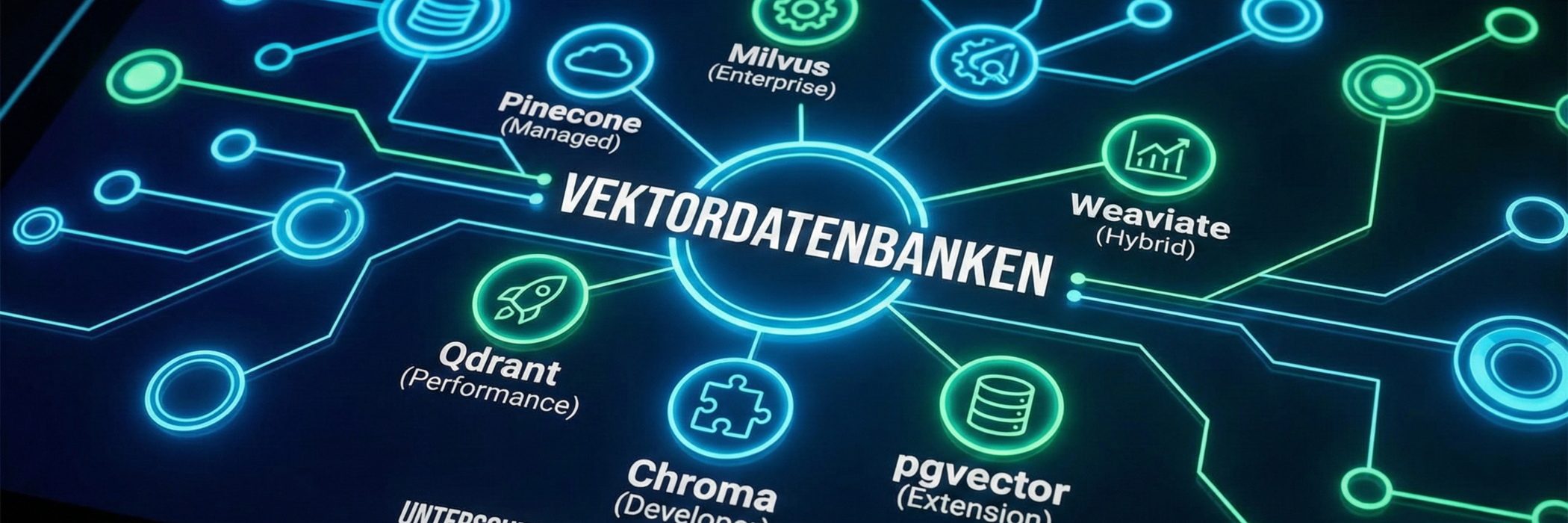
1. chroma (developer-first)
Chroma is the most popular database for prototyping and small and medium-sized projects.
- Special feature: "Plug-and-play" for Python developers.
- Strengths: Very quick to set up, runs locally in a Python instance, ideal for AI chatbots.
2 Pinecone (Native / Managed)
Pinecone is the market leader for teams looking for a zero-ops solution.
- Special feature: It is fully managed (cloud-only). No servers to maintain.
- Strengths: Extremely simple API, fast scaling at the touch of a button, excellent metadata filtering.
- Weaknesses: Proprietary (not open source), can be expensive with huge amounts of data.
3 Milvus (Native / Enterprise)
Milvus is the choice for highly scalable enterprise applications.
- Special feature: Cloud-native, distributed architecture. Can process billions of vectors.
- Strengths: Open source, supports GPU acceleration for extremely fast searches, very flexible indexing algorithms (HNSW, IVF, etc.).
- Weaknesses: High complexity in setup and maintenance (self-hosting).
4 Weaviate (Native / Hybrid)
Weaviate combines vector search with a graph data structure.
- Special feature: Focus on "hybrid search" (combination of keyword search and semantic vector search).
- Strengths: Modular structure, integrates excellently into frameworks such as LangChain, supports GraphQL.
- Weaknesses: Can be memory-intensive with very large amounts of data.
5 Qdrant (Native / Performance)
Qdrant is written in Rust and designed for maximum efficiency.
- Special feature: Very high-performance filtering. You can combine vector searches precisely with conditions (e.g. "only documents from 2024") without losing speed.
- Strengths: Extremely fast, low resource consumption, good open source community.
6. pgvector (extension for PostgreSQL)
This is not a database of its own, but a plugin for the well-known PostgreSQL.Special feature: Allows vectors to be stored directly alongside relational data (SQL).Strengths: If you already use Postgres, you don't need to learn a new system. Full SQL power.Weaknesses: Less optimized for extremely complex vector operations compared to native systems.
How do they differ in essence? The differences lie primarily in three areas:
- Deployment: do you want to worry about nothing (Pinecone), or do you want full control over the hardware (Milvus, Qdrant)?
- Search logic: Do you need a pure vector search, or do you often need to mix it with classic text filters (Weaviate, Qdrant)?
- Scaling: Are you looking for 100,000 documents (Chroma, pgvector) or 10 billion (Milvus, Pinecone)?
Would you like us to help you choose the right database for a specific project?