
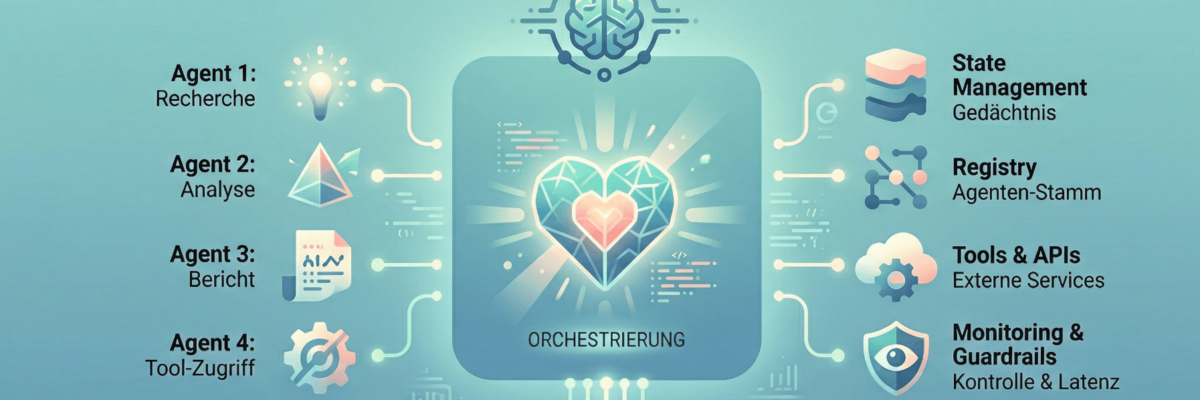
In 2026, however, we have learned that without intelligent backend management, chaos reigns. If you build agent workflows, you build systems with a life of their own - and that can be expensive.
1. the "infinite loop" phenomenon (the digital vicious circle)
The most common cause of blown budgets and glowing servers is the agentic loop. It is usually caused by "excessive politeness" or unclear target definitions.
The scenario:
- Agent A (reviewer): "Your text is good, but please correct the formatting of point 4."
- Agent B (Writer): "Done. Here's the new version."
- Agent A: "Thank you! But now there's a typo in point 3. Please fix it."
- Agent B: "Fix installed. Have a look over it."
- Agent A: "Thank you! But now point 4 is formatted incorrectly again..."
Without cycle detection in the backend, these agents go round in circles until the token limit is reached or the credit card is blocked. Expert tip: A robust backend needs a "hard-stop" mechanism after $n$ iterations or a mathematical divergence check. If the change falls below a threshold, the backend must interrupt the flow.
2. the "silent mail" of hallucinations
When agents communicate, they not only transmit facts, but also uncertainties. In a linear flow, a small error by agent 1 (the researcher) can be interpreted as incontrovertible truth by agent 2 (the analyst).
We call this the hallucination cascade. By the time the information reaches Agent 4, a tiny misinterpretation has turned into a massive misstatement.
The solution of the backend:
- Structured Handoffs: agents are not allowed to pass unstructured text deserts. The backend enforces JSON schemas with mandatory fields for "confidence scores".
- Cross-check agents: Implement an independent "auditor agent" that randomly checks facts against the original source (ground truth) in the vector store.
3. the "context bleed" (information overload)
A classic mistake in the design of communication flows is to send each agent the entire history of the previous conversation.
Above a certain flow depth, this leads to
- Exploding costs (input tokens).
- Model confusion, as the agent loses sight of the current goal ("lost in the middle" phenomenon).
Best practice 2026: Use state-pruning. The backend acts as a filter and only passes on to each agent the part of the "memory" that it really needs for its specific subtask.
4 "Ghost in the machine" governance
What happens if an agent suddenly decides that it needs to call an API to solve a task for which it is not actually authorized? Or if it starts sending sensitive customer data to an external model as a sample context?
An agent backend without a policy layer is a security risk.
- Sandbox execution: Any code that an agent writes or executes must run in an isolated environment.
- Intercept logic: The backend must intercept every outgoing request from an agent and check it against a whitelist.
Conclusion: resilience before intelligence
A single, highly intelligent agent is impressive. A team of agents is powerful. But a team without a management backend is an accident waiting to happen. In 2026, the successful agent architects differ from the amateurs in one simple insight: you don't program the intelligence of the agents - you program the guard rails of their interaction.