
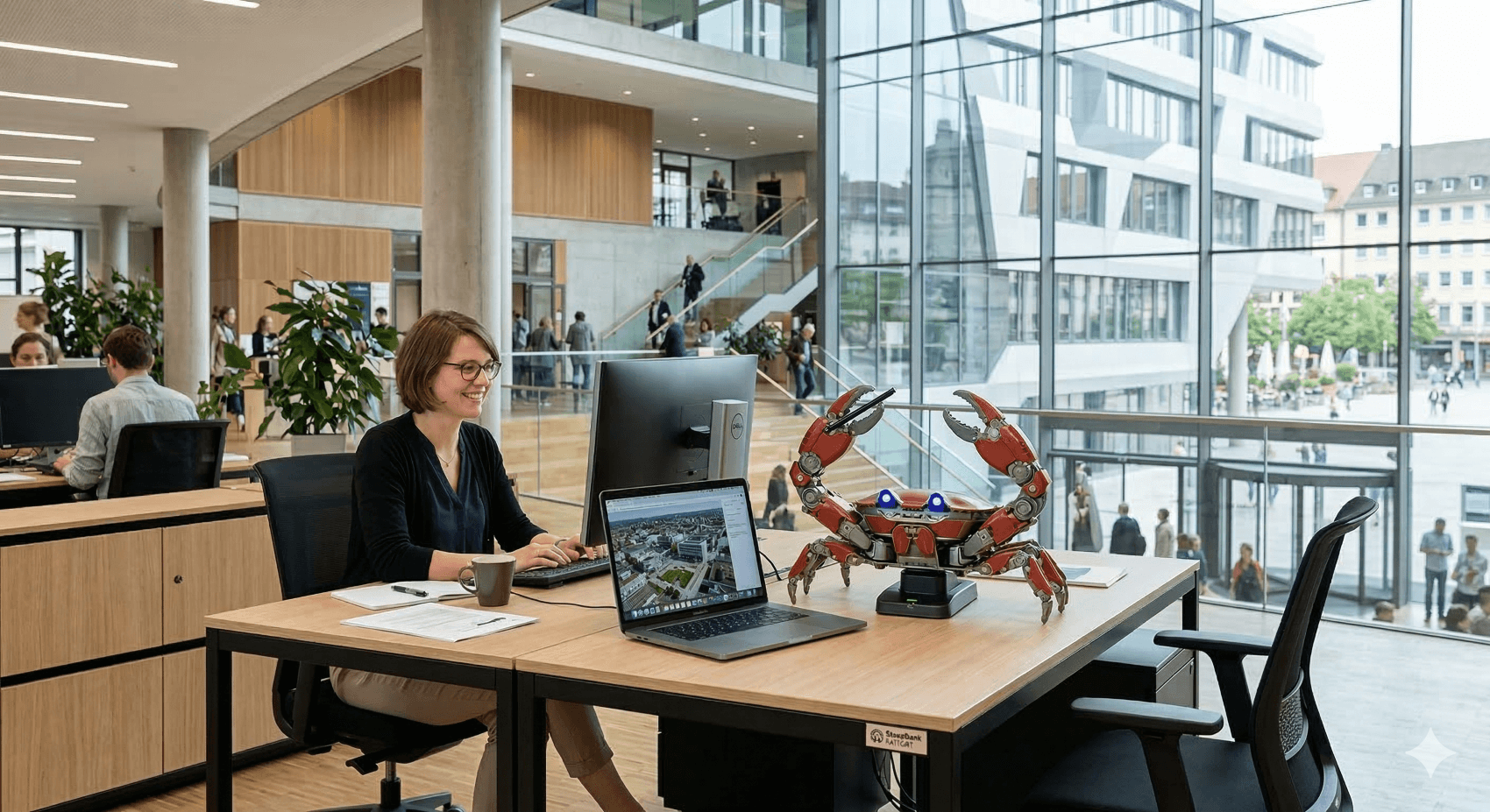
This is where OpenClaw comes in: As an "agentic infrastructure", it provides the necessary runtime environment to link sovereign software stacks with autonomous AI intelligence. The digitalization of administration is on the verge of the next evolutionary stage. Following the provision of online services (OZG) and the creation of sovereign workstations (openDesk), the focus is now shifting to procedural intelligence. How can specialist processes be supported not only digitally, but also autonomously, without losing sovereignty over sensitive citizen data to non-European cloud providers?
The missing layer: why openDesk needs an "agentic layer"
openDesk (the Sovereign Workplace) is the answer to the dependence on proprietary office suites. It provides word processing, e-mail and collaboration on an open source basis. But software alone will not solve the skills shortage. What is missing is an entity that can operate these tools.
OpenClaw acts as the "connective tissue" here. It is not a classic program, but a runtime environment for autonomous agents. In the architecture of public IT, OpenClaw takes on the role of middleware that mediates between the static specialist data and the generative intelligence (LLMs).
Architecture of sovereignty: OpenClaw in the municipal data center
The integration of OpenClaw into the public infrastructure is based on three central pillars:
1. the Model Context Protocol (MCP) as a standard interface
The greatest leverage for municipalities is the use of the MCP. OpenClaw acts as a client that connects to various MCP servers. For the public sector, this means that an IT service provider can develop an MCP server for a specific specialist procedure (e.g. registration). OpenClaw can then read and process data from this procedure - in compliance with all authorizations - without the specialist application itself having to be AI-capable.
2. local-first and data sovereignty
OpenClaw is consistently designed for operation in its own infrastructures. In combination with local language models (e.g. via Ollama or vLLM in the municipal data center), no social data or internal notes leave the secure administrative network. This is the decisive advantage over commercial "copilot" solutions.
3. transparency through "human-in-the-loop"
Administrative actions must be traceable. OpenClaw stores its thought processes and memory content in transparent Markdown structures (SOUL.md). Every step taken by an autonomous agent can be audited. The architecture also allows strict approval processes: Critical actions (e.g. sending a notification) are only executed after explicit confirmation by the agent in openDesk.
Synergy effects: A practical example
What does the interaction look like in a typical municipality?
| Step | Actor / System | Action |
|---|---|---|
| Input | Citizen / e-mail | A complex request for funding programs is received in the openDesk mailbox. |
| Analysis | OpenClaw | The agent recognizes the intention and uses an MCP server to search the funding database. |
| Design | openDesk (Collabora) | OpenClaw automatically creates a response document based on the facts found. |
| Review | Clerk | The employee checks the draft in openDesk and approves it with one click. |
Conclusion: Infrastructure instead of a stand-alone solution
OpenClaw is far more than just a technical toy for the public sector. It is the design of a sovereign automation layer. While openDesk is the user interface of sovereignty, OpenClaw provides the infrastructural logic to make administrative processes more efficient, faster and yet secure. For local authorities, this offers the opportunity to understand the EU's "AI Act" not just as a regulatory hurdle, but as a technological standard: Through open source, local execution and full transparency in the process.