
But what if there was an easier way? A way that utilizes the strengths of classic HTML and still enables modern, dynamic web applications - without complex build tools and JavaScript frameworks? This is exactly where HTMX comes in.
What is HTMX?
HTMX is a small, lightweight JavaScript library that makes it possible to use modern browser functions such as AJAX, WebSockets and CSS transitions directly via HTML attributes. Instead of writing complex JavaScript logic, you add attributes such as hx-post, hx-target or hx-swap to your HTML elements.
The central idea: HTML becomes the primary interface for interactivity again, while the server takes over the logic and rendering.
The advantages of HTMX at a glance:
- Simplicity: If you understand HTML, you can use HTMX productively very quickly - without in-depth JavaScript know-how.
- Lightweight: HTMX is only a few kilobytes in size and requires no additional dependencies or build processes.
- Server-centric architecture: Logic remains in the backend - ideal for classic server stacks such as PHP.
- Good performance: HTML fragments are loaded instead of complete pages or large JavaScript bundles.
- Seamless integration: HTMX works with almost any backend (PHP, Python, Ruby, Node.js).
- Less tooling: No need for complex toolchains like Webpack, Vite or Babel. No node_modules folders...
HTMX vs React: A comparison
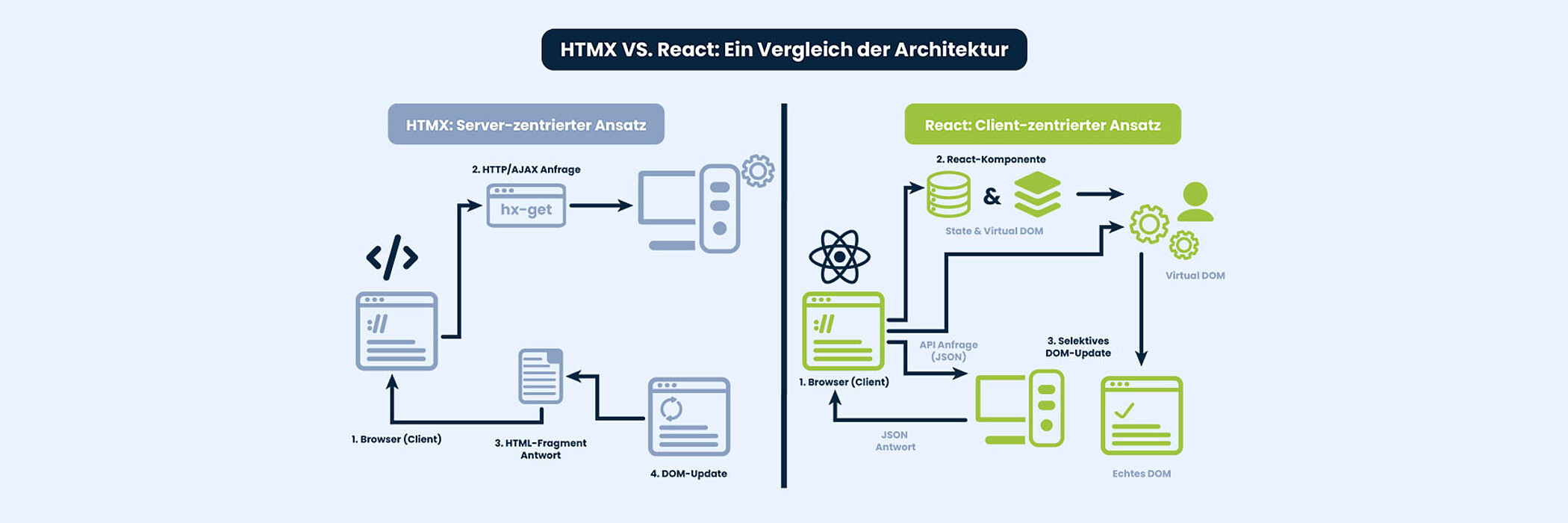
React is a powerful framework for building complex user interfaces. It is based on a component-based approach and uses a virtual DOM to manage changes efficiently. This makes React particularly suitable for highly interactive applications with a lot of client-side state.
However, React also brings additional complexity: build processes, state management (e.g. Redux), routing and often a separation of frontend and backend.
HTMX deliberately takes a different approach: interactivity is created by HTML + server instead of extensive client logic. This significantly reduces complexity and speeds up development.
When is HTMX the better choice?
- CRUD applications: Classic applications with forms, lists and detailed views benefit in particular.
- Server-rendered apps: If your backend renders HTML anyway (e.g. TYPO3, Laravel, Django).
- Fast prototypes: Less setup, faster to results.
- Small teams: Less technology stack means less coordination effort.
When does React have an advantage?
- Very complex UIs with many interactive states (e.g. dashboards, design tools).
- Offline capability or heavily client-side logic.
- Reusable UI components across large projects.
A simple HTMX example with PHP
To illustrate how HTMX works, let's look at a simple example:
<title>HTMX example</title><script src="https://unpkg.com/htmx.org@1.9.10"></script>
HTMX example
<form hx-post="begruessung.php" hx-target="#ergebnis" hx-swap="innerHTML">
<input type="text" id="name" name="name" required=""> <button type="submit">Send</button>
</form>
PHP (begruessung.php):
Hello, $name!";
}
?>
A POST request is sent when the form is submitted. The server response is inserted directly into the element with the ID result - without a complete page reload.
The disadvantages of HTMX
- Server dependency: No interactivity without a server - offline scenarios are difficult.
- State handling: Complex client state is more difficult to implement than in React.
- Less ecosystem: Compared to React, there are fewer libraries and tools.
- HTML coupling: Logic is tied more closely to HTML, which can become confusing for very large projects.
Conclusion
HTMX is not a replacement for React - but an alternative approach. While React shows its strengths in highly complex front ends, HTMX impresses with its simplicity, speed and clear server-centric architecture.
For many classic web applications, HTMX can be the much more pragmatic solution - especially in combination with existing backend systems such as PHP or TYPO3.
The most important insight: not every web application needs a heavyweight front-end framework.