
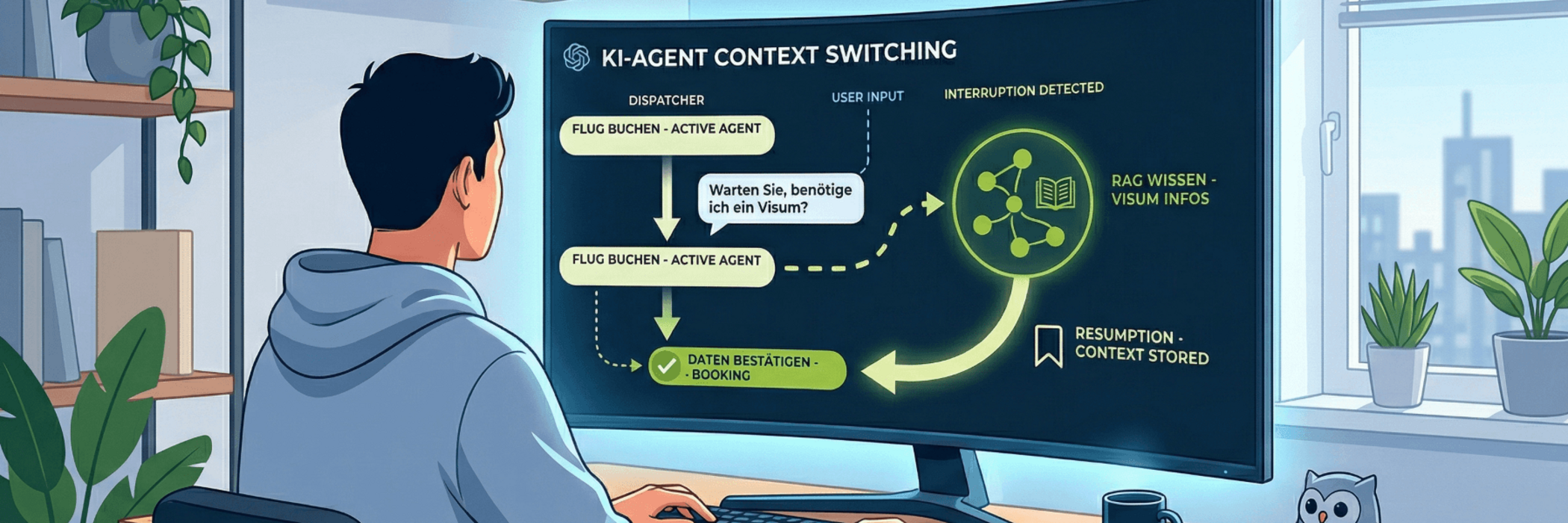
Earlier chatbots would have given up at this point. They had ‘tunnel vision’. Anyone who strayed from the predefined path ended up at a dead end: ‘I didn’t understand you. Please enter a valid date.’ Modern agent architecture solves this problem through contextual switching. It is the part of the brain that allows a bot to set ‘mental bookmarks’.
The problem: the tyranny of linear flow
In classic bot development, we use agents for specific tasks (e.g. a booking agent). As soon as this agent takes control, it is programmed to fill in the blanks: it needs a name, a date and a destination.
The problem: users are not linear. They ask follow-up questions, change their minds or jump between topics. Without contextual switching, every distraction leads to the process being abandoned.
The solution: the ‘stack’ of intentions
Modern dispatcher systems no longer work with simple switches, but with an intent stack (a stack memory).
- Freezing the state: If the user asks a factual question during the booking process (“What are the cancellation terms?”), the dispatcher recognises an interruption intent.
- Context preservation: The current state of the booking agent is ‘parked’. All data collected so far (slots) is retained in short-term memory.
- The digression (RAG): The system briefly switches to the RAG module (Retrieval-Augmented Generation), searches the documents and provides the answer regarding the cancellation.
- The return (Resumption): This is the crucial step. The system checks the stack: “Is there an open task?” Yes, the booking. The bot proactively returns: “By the way, cancellation is free up to 24 hours in advance. Shall we now finalise the booking for 15 October?”
The technical pillars of context switching
For this seamless transition to work, the architecture requires three components:
- Recursive Dispatching
The dispatcher does not sleep whilst an agent is working. It listens in on every user input (background listening). It decides anew at every turn: Does this input still belong to the current agent, or is it a breakaway? - State Management & Payloads
When the bot jumps back and forth between a RAG system and a transaction agent, the data must flow with it. An intelligent bot still ‘remembers’ when jumping back that the user had already given their name before the question. - Ambiguity Handling
Sometimes a switch is unclear. If the user says “Wait, that’s too expensive for me”, this could be the agent being abandoned or just a critical query. Here, the bot uses clarification loops: “Would you like to cancel the booking entirely or look for a cheaper option?”
Why this doubles your bot’s ROI
Contextual switching isn’t a “nice-to-have” – it’s a conversion driver:
- Higher completion rates: Users don’t abandon the chat in frustration if they have a quick follow-up question.
- Human experience: The bot comes across as competent and empathetic, rather than like a digital form.
- Efficiency: Information doesn’t need to be entered twice if the user briefly “goes off track”.
Conclusion: Away from the tree, towards the web
We must stop drawing chat dialogues as decision trees. Real conversations are networks. A modern AI dispatcher is the navigator in this network. It allows the user to move freely without ever losing the thread.