
Pooling knowledge. Control AI. Our AI hub.

The rms AI Hub is the central layer of your AI Suite. It bundles company knowledge from documents, systems and specialist sources - and makes it available for AI Search, AI Assistant, Chatbot and Analytics in a controlled, comprehensible and consistent manner.

➔ No reliable AI without a hub.

Start now

What exactly is the AI Hub?

The AI Hub is the central backend of the rms AI Suite. This is where company knowledge is brought together, processed and managed before it is used by AI applications.

All content - from documents, websites, wikis, DMS or specialist systems - is recorded, analysed and contextualized in a structured manner. Only then is it available for AI Search, AI Assistant, Chatbot and Analytics.

Controlled Knowledge, not a Black Box

The AI Hub ensures that AI does not improvise freely, but only accesses approved, up-to-date and traceable content.

It ensures that AI:

  • only works with consciously linked knowledge

  • provides contextual, consistent and verifiable answers

  • does not generate contradictory or outdated knowledge

➔ The AI Hub is not a black box, but a controllable infrastructure with clear rules for content, rights, sources and use.
Technology in detail

Operating AI securely

Control, data sovereignty and GDPR – right from the start.

Understanding security and GDPR

RAG explained

How AI finds, evaluates and uses knowledge – instead of hallucinating.

Understanding technology

A central layer for all AI applications.

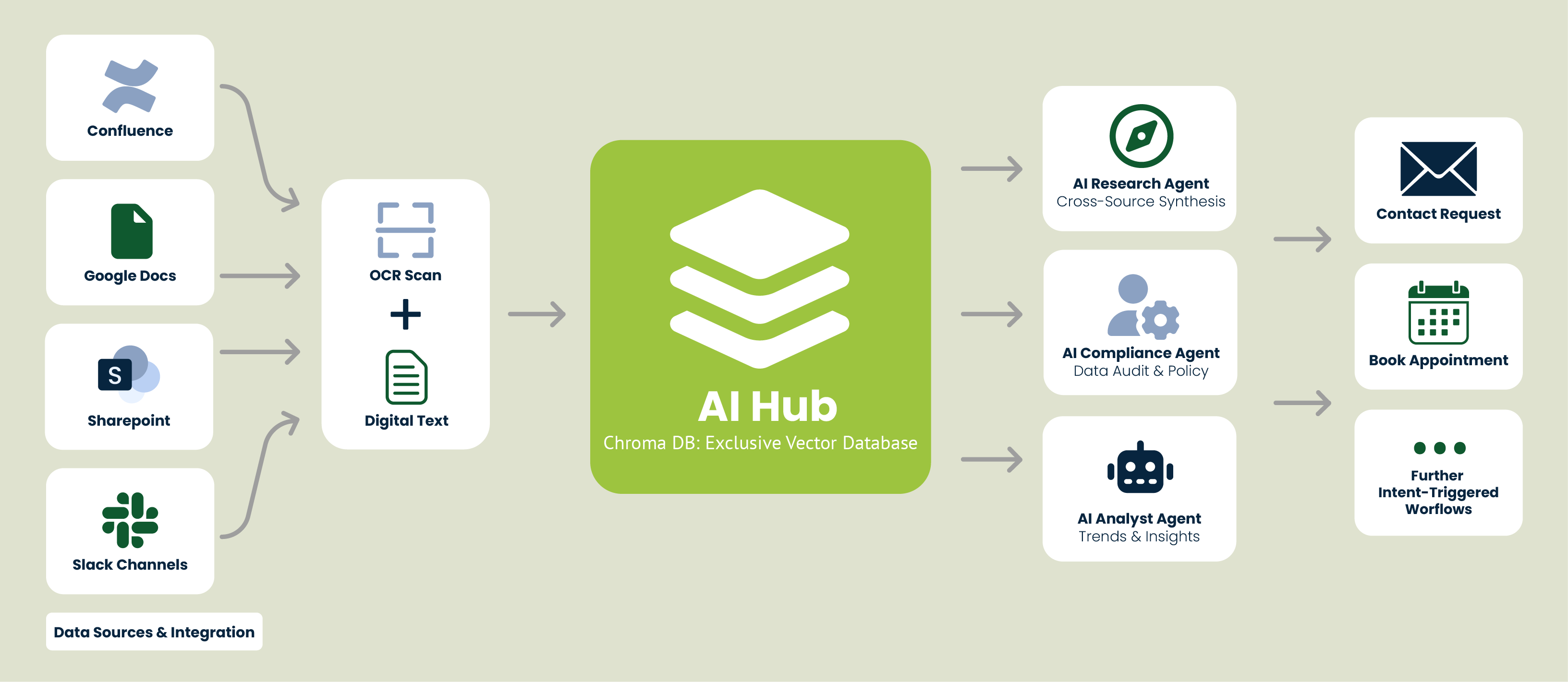
From system to context - controlled via the AI Hub.

The graphic shows how the AI Hub acts as a central layer between your systems and all AI applications.
It collects, processes and controls knowledge from a wide variety of sources - and makes it uniformly usable for search, assistant and chatbot.

FAQ about the AI Hub

What exactly is the AI Hub?

The AI Hub is the central layer of the rms AI Suite.
It bundles content from documents, websites, wikis and specialist systems, prepares it in a structured way and makes it available to all AI modules (AI Search, AI Assistant, Chatbot, Analytics) in a controlled manner.

Is the AI Hub its own AI?

The AI Hub is not AI, but the controllable infrastructure on which AI functions work safely and reliably.
No traceable, trustworthy AI without a Hub.

What content can be connected?

Typical sources are:

  • Documents & files (PDF, Word, Excel, presentations)

  • Websites & CMS content (e.g. TYPO3)

  • Wikis & structured content (e.g. Confluence)

  • DMS & file storage

  • Chats & collaboration (e.g. Slack, Microsoft Teams)

  • Specialist systems & databases (read-only or synchronized)

Does all content automatically go into the AI?

No.
Only deliberately linked and approved content is included in the AI Hub.
Access rights, roles and visibility from the source systems are retained.

How is content processed?

Content is not only stored, but also

  • semantically analyzed and structured

  • extracted from PDFs and scans using OCR

  • broken down into contextually relevant units (chunks)

  • enriched with metadata, sources and timestamps

  • versioned and quality assured

This results in precise, comprehensible AI answers instead of hallucinations.

Is the AI Hub GDPR-compliant?

Yes.
The rms AI Suite is GDPR-compliant, auditable and without data leakage.
Data remains under your control - including on-premise or EU hosting options.

Which language models (LLMs) are supported?

The AI Hub is model-agnostic.
Different LLMs can be connected depending on the application scenario.

The model can be replaced at any time without changing the knowledge base.

What is the difference to classic knowledge management?

Traditional systems manage content.
The AI Hub turns it into contextual knowledge that is:

  • is understood instead of just found

  • Makes sources transparent

  • keeps answers explainable

  • can be used safely by AI

Can the AI Hub be introduced gradually?

Yes.
Many customers start with a source or a use case and expand the hub step by step - technically and organizationally.