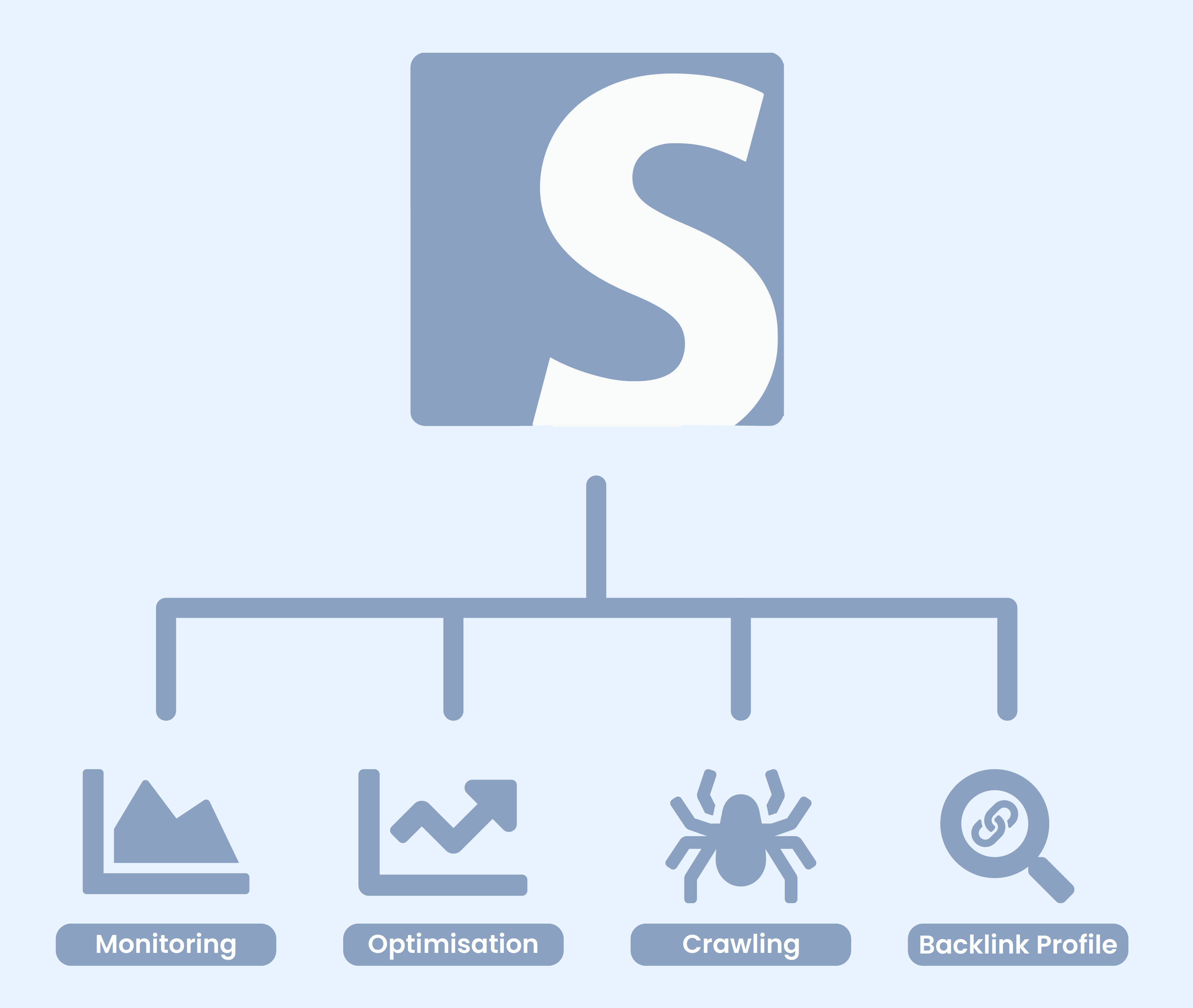
To ensure that our SEO strategies consistently meet high standards and to respond proactively to any technical or content-related weaknesses, we use Seobility as our primary analysis and monitoring tool in our web and TYPO3 projects. This data-driven approach is an integral part of our workflow process.
SEO and accessibility
A technically excellent website only realises its full potential through maximum visibility in search engines. Our SEO strategy encompasses on-page and technical SEO, content architecture tailored to specific target audiences, local SEO and accessibility.
Download the information leaflet
- Keyword & Ranking Monitoring
By precisely tracking relevant keywords, we keep a constant eye on the organic visibility of the domains we manage. Any drop in rankings or keyword cannibalisation becomes immediately apparent, enabling us to take targeted action. - On-page analysis & content optimisation
Seobility helps us specifically identify on-page shortcomings. We identify inadequate meta tags, missing alt attributes, incorrect header structures and duplicate content in order to continuously optimise the editorial quality of TYPO3 websites. - Continuous Website Crawling
We use Seobility’s crawler technology to automatically monitor our enterprise projects for technical errors (such as 404 errors, faulty redirects or slow loading times). This enables us to proactively identify critical vulnerabilities before they can negatively impact rankings. - Backlink monitoring
The backlink profile is crucial for building digital authority. We use Seobility to identify new links and detect potentially harmful links (toxic links) in good time to protect the trustworthiness of our projects.
SEO optimisation in practice: Our case studies



EVIM (evim.de)
Protestant Association for Home Mission
EVIM runs over 60 social services. The SEO strategy for this platform focuses on ensuring that support services and opportunities for involvement can be found easily.
Below are the areas of application within the agency, as well as the benefits and the identification of weaknesses:
Dominikus-Ringeisen-Werk (drw.de)
The DRW is a large church-based foundation dedicated to supporting people with disabilities, the elderly and young people. With over 5,000 employees and numerous locations, this organisation places the highest demands on its digital information architecture.
Below are the key areas of focus for SEO, along with the analysis and implementation:
International Federation (ib.de)
The International Federation (IB) is one of the largest providers of youth, social and educational services in Germany and employs over 14,000 staff. This website is a showcase for highly complex enterprise SEO.
Below are the key SEO focus areas, along with the analysis and implementation:
Accessibility: Digital inclusion as the norm
(WCAG & BFSG)
Inclusive web design is not only an ethical responsibility, but will also become a legal requirement from 2025 onwards under the forthcoming Accessibility Enhancement Act (BFSG). Furthermore, there is a strong synergy between accessibility and search engine optimisation: well-structured, accessible code is rewarded by Google with better rankings. We integrate accessibility standards deeply into our TYPO3 projects.
Semantic HTML & WAI-ARIA
Semantic HTML & WAI-ARIA
We structure our templates using strict, semantic HTML5 (header, nav, main, article). Complex interactive elements such as menus or accordions are tagged with WAI-ARIA attributes to reliably communicate their status (e.g. "expanded" or "collapsed") to screen readers.
Keyboard navigation
Keyboard navigation
Every element of the website that can be operated using a mouse can also be navigated entirely using the keyboard (Tab key). Visible "focus states" (focus borders) and "skip links" (direct links to the main content) ensure smooth navigation without a mouse.
Colour contrast & scalability
Colour contrast & scalability
Right from the design phase, we check all colour palettes to ensure they comply with the WCAG 2.1 AA contrast requirements (at least 4.5:1 for body text). The typography is responsive and can be scaled up to 200% in the browser without any layout breaks.
Editorial support in the CMS
Editorial support in the CMS
Editors must be able to ensure accessibility in their day-to-day work. We configure the TYPO3 backend so that mandatory fields for alt text are enforced for images, link titles can be assigned, and validation checks prevent hierarchical errors in headings.
Front-end tools
Front-end tools
Eye-Able is a comprehensive software solution for digital accessibility that makes websites accessible to all users through an intuitive assistance widget and automated testing tools.
The combination of a robust, flexible enterprise CMS such as TYPO3 as a foundation and a data-driven SEO strategy forms the core of our agency’s services. As our portfolio impressively demonstrates, comprehensive digital portals in the social and institutional sectors require a perfect balance of technical architecture, accessibility and bespoke content marketing. Supported by professional analytics tools such as Seobility, we create high-performing, inclusive platforms that measurably reach people, foster engagement and build lasting digital authority.
Discuss the use case