AI Multi-Agents

Orchestrating intelligence. Mastering complexity.

The rms AI Multi-Agent Approach transforms isolated AI applications into a highly efficient team. We orchestrate specialised AI agents that work together autonomously to solve tasks that go far beyond simple chat.

➔ From simple dialogue to autonomous process chains.

Get started now

What exactly are AI multi-agents?

Whilst a traditional AI chatbot or assistant answers questions, AI multi-agents go a decisive step further: they act as a team of specialists.

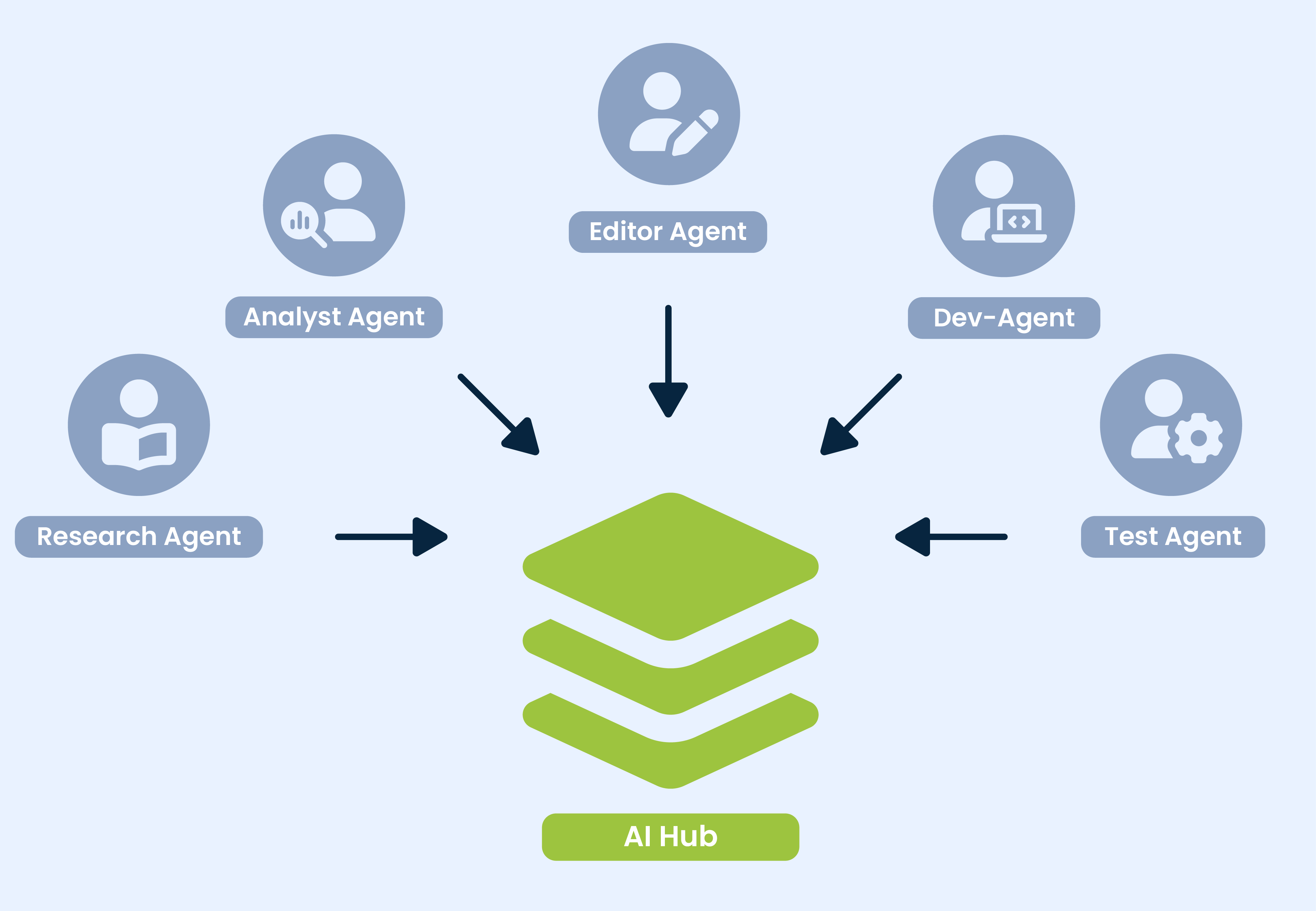
A multi-agent system (MAS) consists of several highly specialised AI instances that take on different roles – for example, a research agent, an analyst and an editor. Controlled by a central orchestration layer (the Agent Orchestrator in the AI Hub), they exchange information, 

Where AI multi-agents make a difference – typical use cases

Whether in research, software development or strategic analysis, multi-agent systems handle the ‘thinking’ in multi-stage processes.

  • Complex reporting & white papers
    One agent researches current market data in the AI Hub, the second analyses trends and the third drafts a structured document in line with the corporate design.
    ➔ Creation of complex documents in minutes rather than days.
  • Automated software development & testing
    A ‘Dev Agent’ writes code snippets, whilst a ‘Tester Agent’ immediately checks them for errors and requests corrections – until the quality is right.
    ➔ Accelerated development cycles and higher code quality.
  • Intelligent market & competitive monitoring
    Agents continuously monitor various data sources, summarise changes and assess their relevance to your strategy.
    ➔ An information advantage without the need for manual research.
From the prompt to the results team

Why multi-agent systems are the next step for your business

Traditional AI models often reach their limits when dealing with very complex or multi-stage tasks (‘agentic failure’). Our multi-agent approach solves this through the division of labour:

➔ The result: greater precision in complex projects and significant time savings thanks to genuine partial automation.

Technology in detail: The rms orchestration layer

We use state-of-the-art architectures to prevent agent chaos:

Agent Registry

Centralised management of each agent’s skills and access rights.

Flow Engine

Fixed (deterministic) or dynamic routing logic for maximum flexibility.

Human-in-the-loop

In the case of critical decisions, the process can be paused so that a person can approve the interim result.

FAQ on AI Multi Agents

What is the difference between an AI assistant and multi-agents?

An AI assistant usually responds to queries on a reactive basis. Multi-agents work proactively and collaboratively within a sequence of tasks (workflow) to achieve a complex objective.

Do multi-agents need their own training?

No. You use the existing LLMs and the knowledge from your AI Hub. The intelligence lies in the allocation of roles and the orchestration.

Is the use of multi-agents safe?

Absolutely. Like the rest of the AI Suite, the agents are GDPR-compliant, involve no data leakage (zero training) and can be deployed entirely on-premises or in a private cloud, if required.

How can an "agentic fail" (AI malfunction) be prevented?

Through clear constraints, budget limits on token usage and automated validation steps between agents in the backend.

Ready for your project?

Together, we will examine how our AI workflows can automate your document and business processes.

Discuss use case