
Large Language Models (LLMs), in particular, promise a huge increase in efficiency. Yet in a legal context, precision is paramount: a single wrong word in a contract or an outdated interpretation of the law can have disastrous consequences.
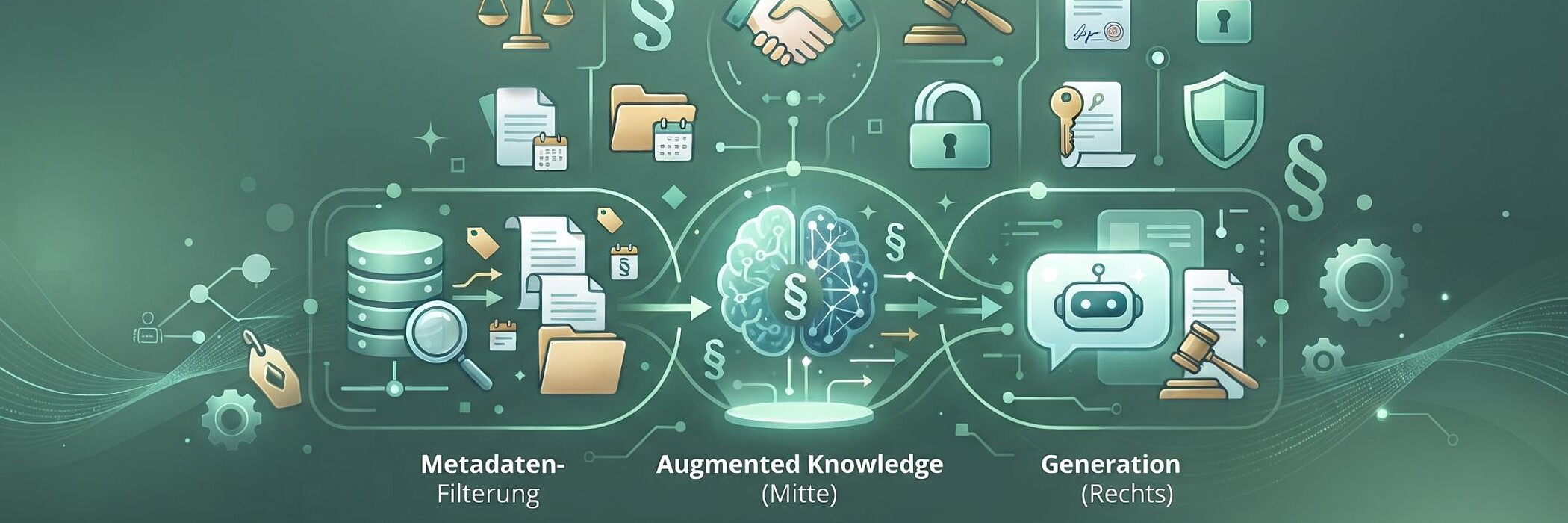
This is where RAG (Retrieval-Augmented Generation) comes into play. In this blog post, we explore what RAG means for legal applications, where the benefits, limitations and hidden potential of meta-information lie, and whether an in-house AI chatbot can significantly ease the workload on the legal department.
1. What is RAG (Retrieval-Augmented Generation)?
Standard AI models (such as ChatGPT) have been trained on vast amounts of data, but tend to ‘hallucinate’ (i.e. make up facts) when faced with very specific or topical questions. Furthermore, they are not familiar with internal company contracts or current policies.
RAG solves this problem through a combination of search and generation:
- Retrieval: When a question is asked, the system searches a defined database in a targeted manner – for example, all the company’s contracts, internal compliance guidelines or a legal database.
- Generation: The relevant text passages found are passed to the AI together with the original question. The AI then formulates a precise answer based on these facts and, ideally, directly cites the source (e.g. ‘See clause 4.2 of model contract X’).
2. The benefits of RAG in the legal sector
- Massive time savings in research: Lawyers spend a large proportion of their working hours searching for precedents, legislative changes or internal company precedents. RAG delivers relevant text passages in a matter of seconds.
- Reduction in ‘hallucinations’: As the AI derives its answers strictly from the stored, verified documents, the risk of fabricated clauses or judgements is drastically reduced.
- Preservation of confidentiality: Internal RAG systems can be operated locally or in secure cloud environments (e.g. GDPR-compliant). Sensitive company data is not used in the public training of external models.
- Consistent knowledge base: All staff members have access to the same, up-to-date templates and guidelines, which enhances consistency in contract drafting.
3. The turbo boost for structure: the potential of metadata
If documents
are simply entered ‘raw’ into an RAG system, the AI quickly reaches its limits – because contracts and laws are highly complex, structured entities. This is where meta-information (metadata) offers enormous potential for intelligently pre-structuring the database:
What is metadata in a legal context?
It refers to structured supplementary information relating to a document, such as:
- Document type: (e.g. NDA, tenancy agreement, licence agreement, terms and conditions)
- Validity & status: (e.g. ‘active’, ‘outdated’, ‘draft’, ‘terminated’)
- Contracting parties & jurisdiction: (e.g. German law, Swiss law, US law)
- Terms & deadlines: (e.g. notice period until 31 December 2026)
- How metadata is revolutionising AI search:
- Targeted filtering instead of blind searching: When an employee asks for a liability clause, the system can use metadata to search only within active contracts governed by German law, automatically excluding drafts or expired contracts. This prevents the AI from recommending outdated clauses.
- Contextual linking: The AI immediately understands the business or legal context of the enquiry. This drastically minimises misunderstandings.
- Automated deadline and risk management: Thanks to structured metadata, chatbots can not only answer questions but also issue proactive warnings (e.g. ‘Please note: framework agreement X expires in 30 days and contains clause Y’).
4. The Limits of AI and RAG
Despite state-of-the-art technology and intelligent metadata, there are clear limitations that must be taken into account in the legal sector:
- No substitute for legal judgement: AI does not understand the law, but rather analyses patterns in texts. The interpretation of vague legal terms or strategic risk assessment requires human expertise.
- Quality of the data set (“Garbage in, garbage out”): If internal documents are incorrectly tagged or incomplete, the quality of the RAG outputs will suffer as a result. Metadata must be maintained.
- Liability: Responsibility for legal assessments always lies with a human (a solicitor or in-house lawyer). AI cannot independently provide legal advice within the meaning of the Legal Services Act (RDG).
5. Can an internal chatbot ease the workload on the legal department?
Yes, but primarily by automating standard enquiries.
In many companies, the legal department is a classic ‘bottleneck’. Business departments repeatedly ask the same standard questions:
- ‘Which liability clause must we use in this standard NDA?’
- “Up to what amount am I authorised to grant this discount?”
- An in-house RAG chatbot (supported by clean metadata) acts as ‘first-level support’:
- Relieving the burden of routine tasks: standard queries are answered directly, round the clock. The legal department gains valuable time for complex negotiations.
- Self-service for sales: Staff can review contracts more quickly, as the AI immediately identifies the appropriate, up-to-date templates thanks to metadata.
- Efficient onboarding: New team members get up to speed more quickly thanks to structured knowledge bases.
Conclusion
RAG-based AI systems combined with intelligent metadata are a powerful tool for the modern legal department. They transform chaotic mountains of documents into a structured, quickly accessible knowledge database. When used as an assistance system, they can significantly speed up routine processes and noticeably reduce the workload on the legal department.