
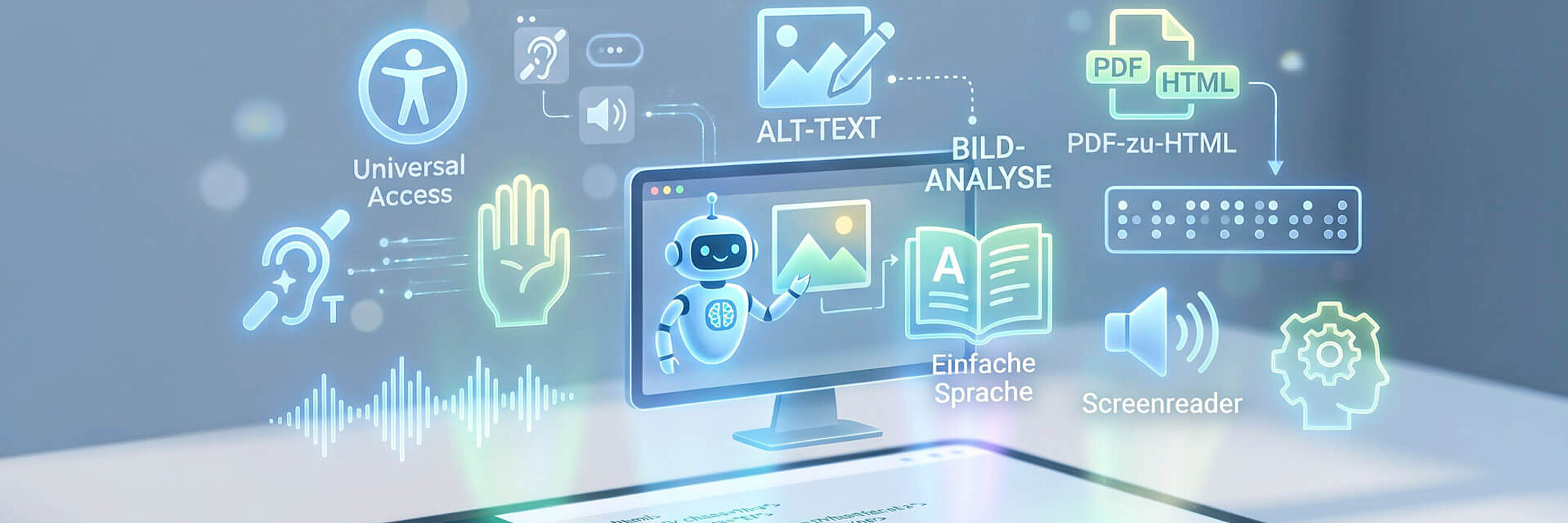
With the BFSG, BITV 2.0 and EN 301 549, the demands placed on ongoing content maintenance are increasing – from meaningful alternative text in the FAL and descriptive link text to accessible language and the management of existing PDF archives.
AI can significantly ease the burden on editorial teams in precisely these areas. However, it is not an ‘autopilot’ for compliance. Anyone who publishes generated alt text, simplified text or extracted tables without checking them risks factual inaccuracies and a false sense of security regarding legal obligations.
In our new Deep Tech Report & White Paper, we take a sober look at how AI-supported accessibility can be seamlessly integrated into TYPO3 v13/v14 – and where binding limits must be set:
- Legal Classification & Compliance Matrix: Distinction between the BFSG, BITV 2.0 and EN 301 549, as well as specific mapping to relevant WCAG success criteria (including 1.1.1, 1.2.2 and 2.4.4).
- Four editorial areas of application: Two-tier, context-sensitive alt text in the FAL, plain and simple language as content variants, semantic pre-publish checks and an HTML-first pipeline as an accessible alternative to PDFs – clearly distinguished from genuine PDF/UA conversion.
- Risks of errors & governance: Specific weaknesses in current models and why ‘human-in-the-loop’ processes, the dual-control principle and manual screen reader checks remain indispensable.
- Technical architecture: Data flow, asynchronous processing via the Symfony Messenger queue, status management in TYPO3 Workspaces, role-based access control and a data protection-compliant API integration.
The full white paper is now available for download.