
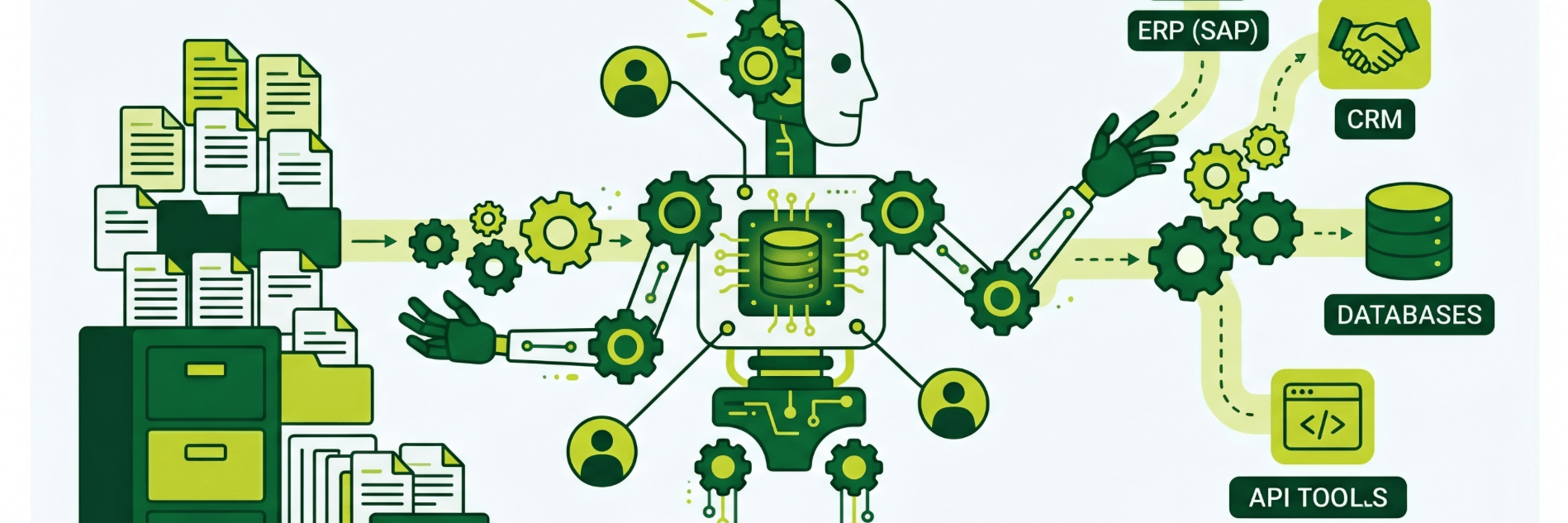
However, these passive systems come up against a crucial limitation: whilst they provide answers, they do not carry out any actions. Employees must still interpret the information manually and transfer it to third-party systems.
The next stage of evolution breaks down this silo: autonomous agent infrastructures.
By combining a highly precise, multimodal ingestion pipeline (using Kreuzberg-PDF, Tesseract and PaddleOCR) with a scalable vector database (ChromaDB), we create a knowledge base that is uncompromisingly reliable. The agent layer brings this data to life: supported by the universal Model Context Protocol (MCP) and iterative ReAct cognitive loops, modern language models no longer act merely as advisors, but as active colleagues. They check parameters, communicate via standardised interfaces with systems such as ERPs or CMS (e.g. TYPO3) and execute complex business processes independently.
To ensure that autonomy does not descend into chaos, deterministic state machines and clear human-in-the-loop interfaces guarantee absolute governance. Based on sophisticated open-weight models (such as Mistral, Llama or Qwen), the entire value chain remains in your own hands, in full compliance with data protection regulations.
Find out in our latest white paper how to make the leap from passive searching to autonomous end-to-end execution and seamlessly integrate AI systems into your IT landscape.
Download the white paper “Whitepaper_RAG_and_Agents_Enterprise”