
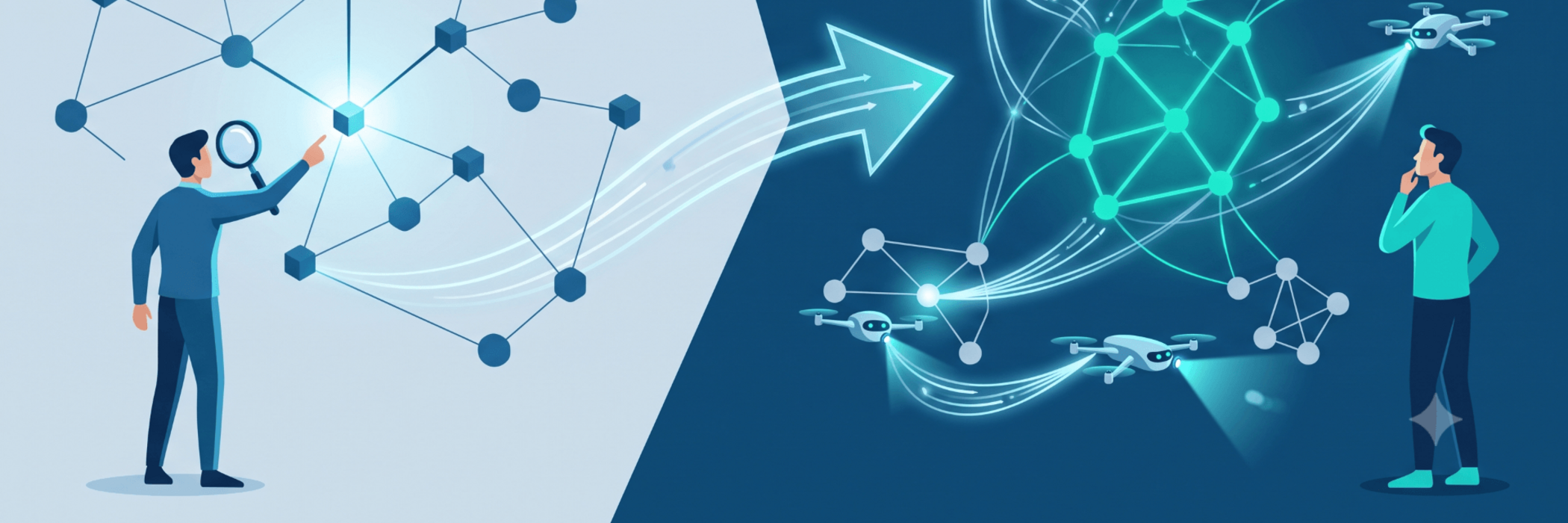
Many modern IT architectures already use vector databases and Retrieval-Augmented Generation (RAG) to make this knowledge accessible. But let’s be honest: anyone who uses vector databases merely as a better, semantic search tool is failing to realise their true potential. The real evolutionary leap lies in the shift from reactive search to proactive pattern recognition via autonomous multi-agent systems.
The autonomous logistics centre:
A new perspective on data. To understand the principle, consider this analogy: imagine a vector database as a huge, state-of-the-art logistics centre. Documents are not simply sorted alphabetically there, but are positioned within the space according to similarity of content – so related topics are physically placed next to one another.
- Traditional RAG search is like a forklift truck that is specifically instructed to fetch a single, precisely defined pallet. The system only reacts when a human asks a question.
- An AI agent, on the other hand, works like an autonomous quality inspector who roams the aisles day and night. Without an explicit instruction, it notices when a conspicuously large number of damaged returns from completely different suppliers end up in a particular corner. It recognises the bigger picture autonomously and continuously.
A real-world example: the invisible onboarding dilemma
What does this look like in real life? Let’s take an IT agency that supports 50 clients in the field of content management systems. Within six weeks, isolated incidents occur with five different new clients: Sometimes SEO mapping is delayed, sometimes image metadata generation falters, and sometimes there’s an API timeout. For the support staff member dealing with each case, these are everyday problems that are quickly resolved – ticket closed, file archived.
However, an AI analysis agent operating in the background re-evaluates the entire vector space every night. In doing so, it discovers that the vectors of these five seemingly unrelated cases lie extremely close to one another in the high-dimensional space. It combines the text segments and delivers the crucial insight:
- The cause: all affected systems are using the same core version in combination with a PHP memory limit that is set too low, which leads to unlogged memory bottlenecks during large batch processes handled by the AI interface.
- The solution: The agent recommends a proactive update to the standard onboarding playbook for all remaining 45 customer instances. The systemic problem is nipped in the bud before a full-blown crisis arises. The four key benefits of knowledge management
This agent-based pattern recognition offers companies four key strategic advantages:
- Detection of semantic drift: Agents monitor shifts over time in the vector focus of customer enquiries to identify new market trends or changing customer needs at an early stage.
- Detection of knowledge silos: Isolated data clusters without semantic links to other departments are identified, thereby avoiding duplication of effort and bringing together expert knowledge.
- Consistency and compliance checks: By automatically cross-referencing policies with operational texts, outdated documents or legal risks can be uncovered.
- Autonomous synthesis: Multiple agents extract key points from scattered clusters and independently draft summaries for management dashboards.
The technology behind the scenes
A modern tech stack for such an early-warning system clearly separates data storage from agent logic and is based on three pillars:
- The semantic store (vector DB): Systems such as ChromaDB, Qdrant or pgvector store high-resolution text chunks. Intelligent, context-sensitive chunking ensures that the agent retains the exact context.
- The agent framework: Tools such as LangGraph or CrewAI enable cyclical workflows (loops). The agent can formulate a hypothesis, query the vector space, discard results and autonomously adapt its strategy.
- The Model Context Protocol (MCP): It standardises the bridge between LLM agents and internal systems, decouples the logic from proprietary APIs and ensures maximum flexibility in routing.
The path to a production system:
Operational Excellence: To transform a functioning prototype into a robust production system, five key aspects must be prioritised:
- Base quality: The embedding model must be precisely tailored to the specific domain in order to accurately capture semantic nuances.
- Validation: Static filters and cross-referencing minimise false positives.
- Security & Governance: The GDPR requires strict anonymisation; furthermore, a ‘human-in-the-loop’ approach is applied, whereby the agent provides advice but a human validates critical decisions.
- Operations & Finance: Monitoring tools ensure stability, whilst smart cost management optimises token consumption.
- Robustness: Verification mechanisms such as self-consistency checks and direct source references to the vector data prevent hallucinations.
Conclusion: The future is proactive
The mere storage of knowledge has been resolved and semantic search works. The next frontier in knowledge management is autonomous curation. Companies that now make the transition from passive RAG architecture to active, agent-based pattern recognition secure an invaluable competitive advantage: They solve problems even before the customer realises they had one in the first place.
Download white paper: Deep Dive – From Searching to Anticipating – AI Agents