
The idea: we let the AI write its own highly complex instructions, rather than spending ages trying to come up with the perfect prompt ourselves. The result is significantly more precise, higher-quality text, code or analysis. But as ingenious as meta-prompting works in the private chat window of Gemini or ChatGPT – in a business context, the constant copy-and-pasting of interim results quickly reaches its limits. Not every employee is a trained prompt engineer.
The solution? We’ve integrated meta-prompting into a central software architecture: the AI Hub.
From chat window to enterprise architecture
An AI Hub transforms clever text tricks into highly scalable processes. It abstracts the complexity through prompt chaining (linking prompts in the background) and intuitive user interfaces. To the end user, the system looks like a simple form. But under the bonnet, complex meta-prompt chains are running. Our case study below shows how this works in practice.
Case study: The "EcoSprint" launch in the AI Hub
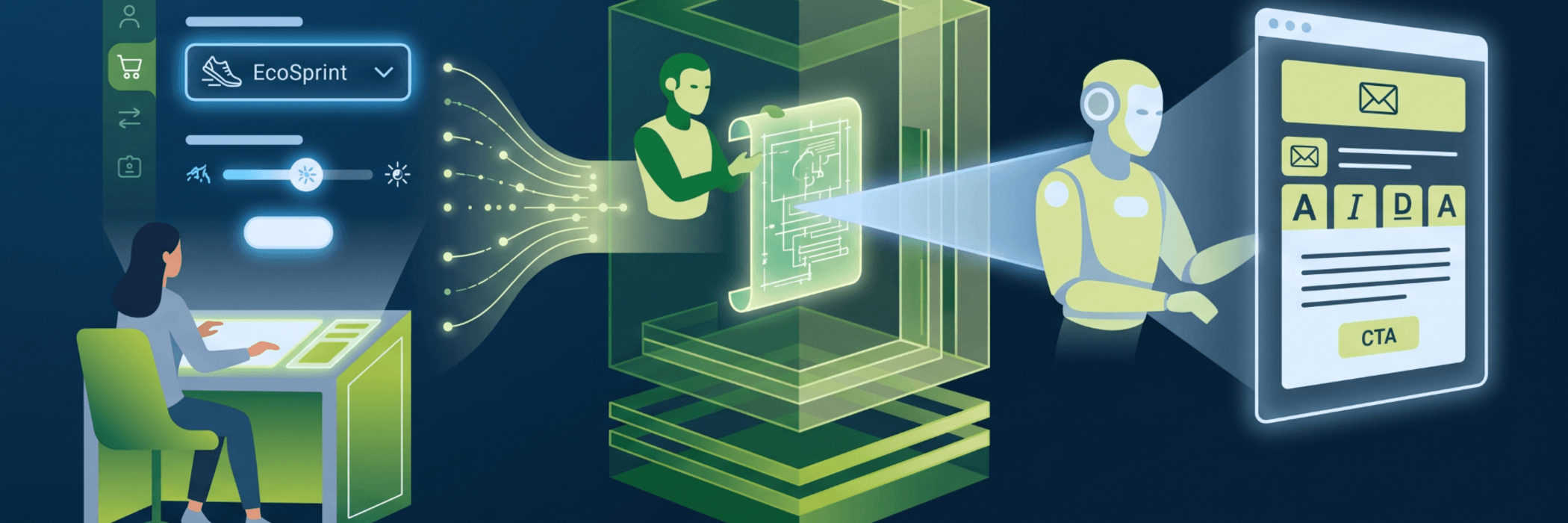
Let’s imagine Sarah, a marketing manager at a sports goods company. She is tasked with writing the email newsletter for the new “EcoSprint” running shoe. Instead of interacting with the AI herself, she uses her employer’s internal Marketing AI Hub.
This is what the seamless process looks like:
1. The intelligent briefing (the front end)
Sarah opens the “Campaign Creator” module. She doesn’t type in any complicated commands, but simply selects parameters:
- Product: Using a drop-down menu, she selects the “EcoSprint”. The AI Hub is linked to the company’s PIM system (product database) and automatically retrieves all relevant specifications in the background (e.g. “100% ocean plastic”, “ultra-light”).
- Goal: Newsletter launch.
- Tone: She sets the slider to “Dynamic” and “Professional”.
2. The invisible meta-prompt (the backend)
As soon as Sarah clicks Generate, the real magic begins. The AI Hub takes her inputs and feeds them into a meta-prompt firmly anchored within the system.
This instructs an internal AI instance: “Using these variables, create the perfect system prompt for a copywriter, based on the AIDA model and our company guidelines.”
The result is a highly complex master prompt. The genius of it is that Sarah never sees this prompt.
3. Automated execution (prompt chaining)
In the next fraction of a second, the hub takes this newly generated master prompt and automatically sends it to the most powerful text model available. The AI now composes the newsletter – precisely according to the strict specifications of the invisible master prompt.
4. The finished result (back in the frontend)
A few seconds later, Sarah receives the finished result on her screen: three snappy subject lines to choose from and a newsletter text perfectly structured according to the AIDA principle.
If she wants changes, she simply clicks on buttons such as ‘Make it shorter’ or ‘More focus on sustainability’. The hub then automatically fires off the next, perfectly formulated meta-prompt in the background.
Why this approach is a game-changer
When companies integrate meta-prompting into an AI hub, they take their AI strategy to the next level. This has three key advantages:
- Democratisation of expert knowledge: Employees no longer need to be prompt engineers. Expert knowledge of frameworks (such as AIDA), character limits and tone is hard-wired into the hub’s architecture. Suddenly, everyone on the team delivers top-quality results.
- Corporate compliance & guardrails: The hub acts as a safety barrier. It ensures that the invisible meta-prompts always incorporate company guidelines (e.g. no false claims of healing, correct gender-neutral language, adherence to tone of voice) into the final output. The AI can no longer ‘run amok’.
- Centralised A/B Testing & Updates: If the marketing team finds that a different text framework works better, the developers can centrally adjust the hidden meta-prompt in the backend. All employees immediately benefit from the improved results without having to change their own workflow.
Conclusion: The machine controls the machine
The use of AI Hubs reduces manual prompting to a purely backend process. Constructing prompts becomes a seamless, automated software experience. Humans shift from the role of commander to that of strategist and curator – whilst the AI forges its own tools in the background to do the best work for us.