
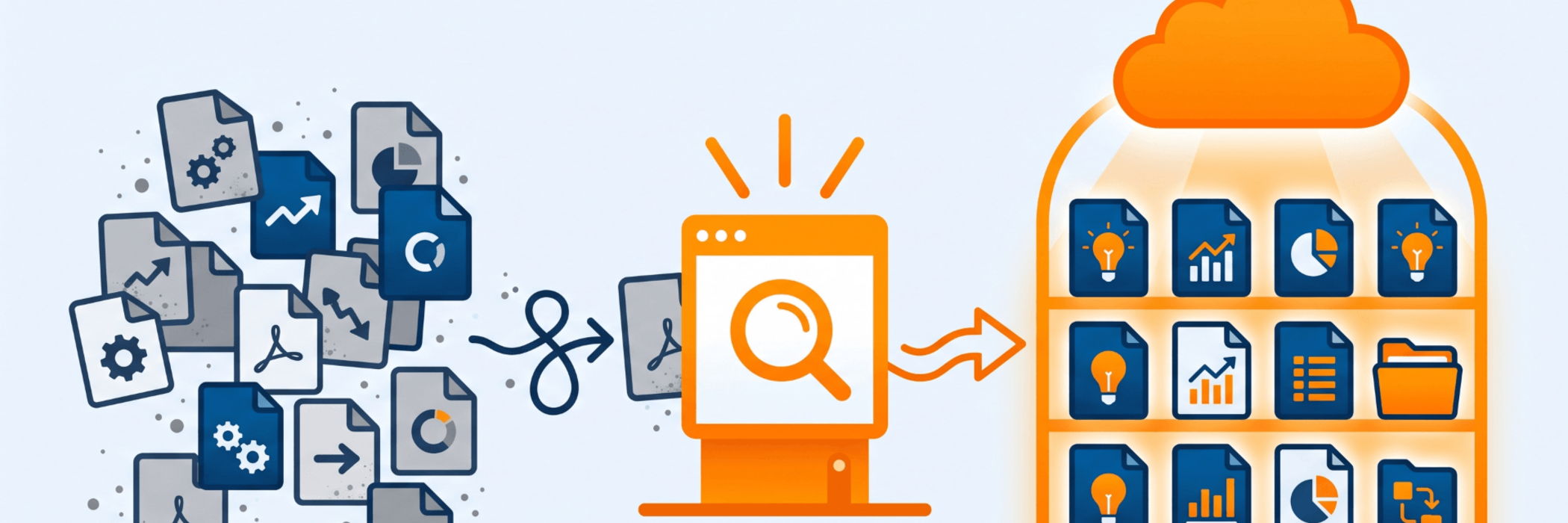
Continuous text has long been standard fare for modern language models (LLMs). Yet as soon as the pipeline encounters the real treasures of corporate knowledge – balance sheets, quarterly reports, technical diagrams or process charts – the system often hits a brick wall.
Tables and visual graphics in PDFs are the ultimate ‘boss battle’ for data extraction. Anyone who treats them like plain text is feeding their vector database with junk data. The result? The RAG system starts to ‘hallucinate’, fails to find key figures or provides incorrect information. To defeat this final boss, companies must rely on specialised parsers and multimodal AI.
Why traditional PDF parsing fails
Conventional PDF parsers, such as those built into many standard frameworks, have a fundamental problem: they are blind to layouts. They stubbornly read a document from top left to bottom right – line by line. When dealing with a table, this approach inevitably leads to disaster, as columns merge mercilessly into one another. The logical relationship between a row heading (such as ‘Turnover 2025’) and a column heading (such as ‘EMEA region’) breaks down completely.
Visual elements are hit even harder: charts, flowcharts or CAD drawings are either completely ignored or result in cryptic gibberish in the extracted text. For your RAG system, this means that the embedding model generates mathematical vectors from a jumble of unstructured numbers. If a user later queries specific key figures, the AI searches a database full of fragments without context – and fails.
Strategy 1: Layout-aware parsing for structured tables
To parse tables cleanly, purely line-based extraction must be abandoned. Modern, layout-aware parsers such as LlamaParse or Unstructured use machine learning models to analyse the visual structure of a document before the text is extracted. Instead of breaking the table down into individual lines of text, these parsers transform the table structure into a format that LLMs understand natively: Markdown.
As LLMs have been trained on vast amounts of code and structured documentation, they are exceptionally good at interpreting these Markdown matrices and their relational dependencies.
In practice, this also means that standardised metadata should be injected during the process known as ‘chunking’ – the breaking down of the text into manageable chunks. As an isolated table section is worthless on its own, a clean import process automatically links it to metadata such as the document name and the specific chapter.
Strategy 2: Multimodal AI for graphics and complex diagrams
But what happens to elements that cannot be translated into a traditional text table? A technical architecture diagram or an infographic cannot simply be squeezed into rows and columns. This is where the real game-changer comes into play: multimodal AI (Vision-LLMs) such as GPT-4o or Claude 3.5 Sonnet. Instead of attempting to parse the code behind the graphic, these models treat the PDF page or the isolated graphic as an image.
The workflow is divided into three clear steps: first, the PDF loader detects an image element in the document and extracts it as a separate image file. In the second step, the image is passed to the Vision LLM, guided by a precise system prompt. This prompts the AI to analyse the structure, all axis labels, data points and the logical flow of the components in detail. In the final step, the LLM generates a highly accurate text description that fully replaces the graph in your RAG pipeline.
The optimal import pipeline: the hybrid approach
For a production-ready enterprise RAG system, an intelligent, multi-track import pipeline that processes all elements in parallel is therefore recommended. The process begins with the layout analysis and segmentation of the entire PDF.
The content is then split up: normal running text is routed to standard chunking. Tables are converted directly into Markdown using specialised parsers. Graphics and diagrams are simultaneously sent to a vision LLM, which formulates detailed textual descriptions from them. Finally, all three data streams are enriched with the appropriate metadata and flow together into the vector database as semantically valuable information.
Conclusion: Quality wins
Anyone wishing to defeat the final boss that is PDF extraction must abandon the notion that PDFs are merely complicated text files. Only the combination of layout-aware parsers for tables and multimodal AI for visual content makes your database truly ‘AI-ready’. The effort involved in implementing such a hybrid pipeline pays off, at the very latest, when your users ask complex questions – and the AI provides the correct answer down to the last cent.