
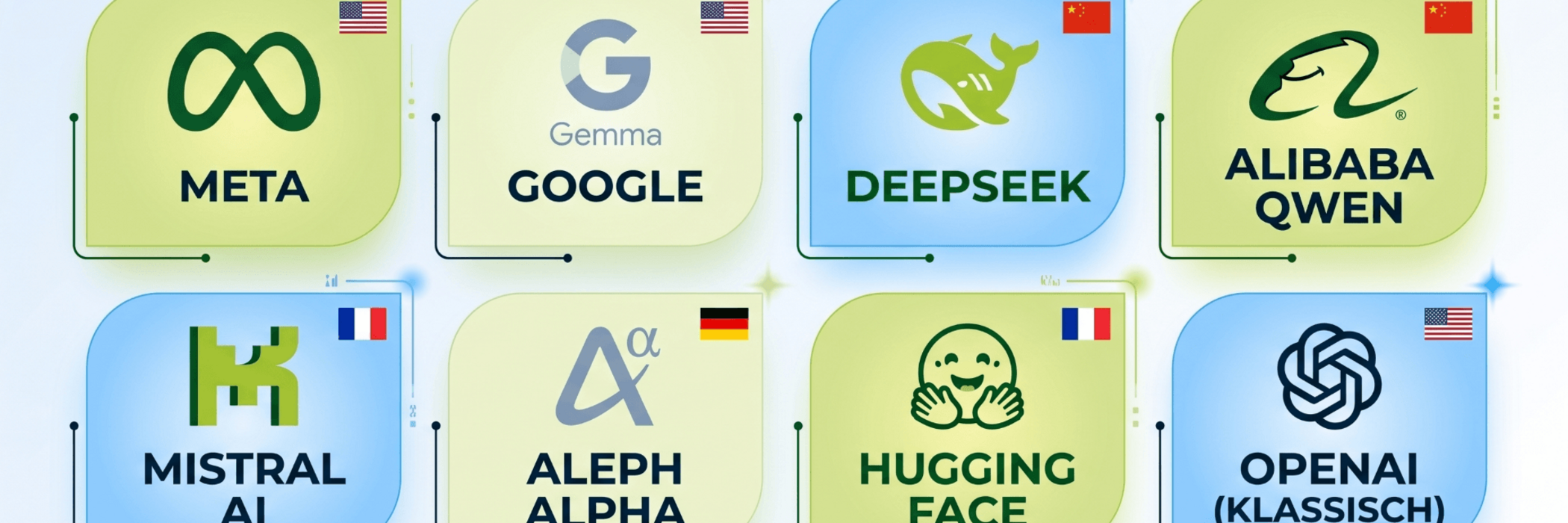
The market for freely accessible language models – known in technical jargon as open-weights models – has long since become the battleground for a fierce geopolitical proxy war. Whilst the US is strategically flooding the market and China is spearheading an efficiency revolution, Europe is busily drafting the rules of the game – for a game in which it is barely even participating.
1. USA: The ‘open-ish’ model as a Trojan horse
When Meta touts its Llama models or Google its Gemma series as a ‘gift to the developer community’, one should read the small print. US tech giants do not give away billions in investments out of charity.
The strategy: Open source is being used here as an economic defensive weapon. By providing cutting-edge AI as infrastructure free of charge, Meta is destroying the business models of closed-source competitors such as OpenAI or Anthropic. Why pay expensive API fees when you can host a Llama model yourself?
The hypocrisy: this has little to do with genuine open source (as per the OSI standard). The licences often explicitly prohibit major tech competitors from using the models without special permission. It is a controlled ecosystem that ties developers to the toolchains of US corporations.
The advantage: infinite financial resources. The US models excel thanks to their vast general knowledge, excellent multimodality (text, image and audio seamlessly integrated) and enormous context windows.
2. China: Algorithmic brilliance in the shadow of sanctions
The biggest surprise of recent years is unfolding in China. Model series such as Qwen (Alibaba) and, above all, the groundbreaking releases from DeepSeek have caught Silicon Valley off guard. China has proven that you can run incredibly fast even with the handbrake on.
The strategy: making a virtue of necessity. Because the US has blocked the export of high-end chips (such as Nvidia’s H100/H200) to China, Chinese engineers have had to become algorithmically ingenious. They have optimised the MoE (Mixture-of-Experts) design – in which only a small part of the model is active at any given computational step – so radically that they outclass Western models in terms of price-performance, coding and complex mathematics.
The critical weak point: the ideological guardrail. Every Chinese model must comply with the strict guidelines of the Cyberspace Administration of China (CAC). As soon as questions touch on the history of the Communist Party, geopolitics or social taboos, the models go into a stubborn mode, hallucinate about party loyalty or refuse to answer. This makes them psychologically and practically unreliable for open-ended use in businesses worldwide.
3. Europe: The world champion of regulation in a vacuum
And Europe? Europe is essentially watching the clash of the titans from the stands whilst polishing its rulebook. France’s Mistral AI is bravely flying the European flag, but under economic pressure is increasingly transforming itself into a commercial API provider.
The strategy: “Sovereignty through legislation”. Europe is banking on local companies’ fears of US espionage and Chinese censorship. The focus is entirely on GDPR compliance and local control.
The regulatory stranglehold: The EU AI Act means well, but in practice often acts as a brake on innovation. The strict obligations for developers of General Purpose AI – ranging from comprehensive copyright attributions in training data to systemic risk assessments – are stifling European start-ups before they can even raise the necessary venture capital.
The reality: whilst the US is mobilising billions in private capital and China is building state-funded GPU clusters, Europe is attempting to scale up AI through funding applications and ethics committees. The result is robust models that, however, usually lag behind the technological frontier.
A direct comparison of the three AI approaches
| Region | Leading providers | The real driving force | The systemic risk |
|---|---|---|---|
| USA | Meta (Llama), Google (Gemma) | Breaking up monopolies, ecosystem lock-in | Platform dependency: Aggressive, imperial ‘open-ish’ on their own terms. |
| China | DeepSeek, Alibaba (Qwen) | Circumvention of US sanctions, national self-sufficiency | Castrated knowledge base: Content blocks on politically sensitive topics. |
| Europe | Mistral AI, Aleph Alpha | Digital sovereignty, enterprise compliance | Bureaucratic paralysis: stifling of innovation by the EU AI Act amid acute capital shortages. |
Who uses what – and why?
This dynamic is reflected precisely in global usage patterns. In the US, developers primarily use open source to free themselves from the shackles of OpenAI’s pricing structures through fine-tuning with their own data.
In China, the integration of home-grown models into industry (e-commerce, manufacturing, logistics) is booming at a breathtaking pace. As Western APIs are blocked, the only option is a radical focus on their own open-source architectures – particularly in the field of edge AI, i.e. AI running directly on the user’s device.
In Europe, by contrast, there is often paralysis. Companies want to use the technology but spend months on compliance checks. The theoretically appealing idea of running open-source models entirely on their own servers (on-premise) for data protection reasons usually fails in practice due to the exorbitant hardware costs and the lack of skilled personnel capable of maintaining complex MoE architectures in the first place.
The conclusion:
The US has the capital, China has algorithmic efficiency born of necessity – and Europe has the legal code. Unless Europe urgently channels massive investment into its own data centre infrastructure and creates pragmatic scope for open-source research, we run the risk of being relegated to a mere digital colony in the AI age. We will then have the best-protected data in the world, but no longer any technology to which we can apply it.