
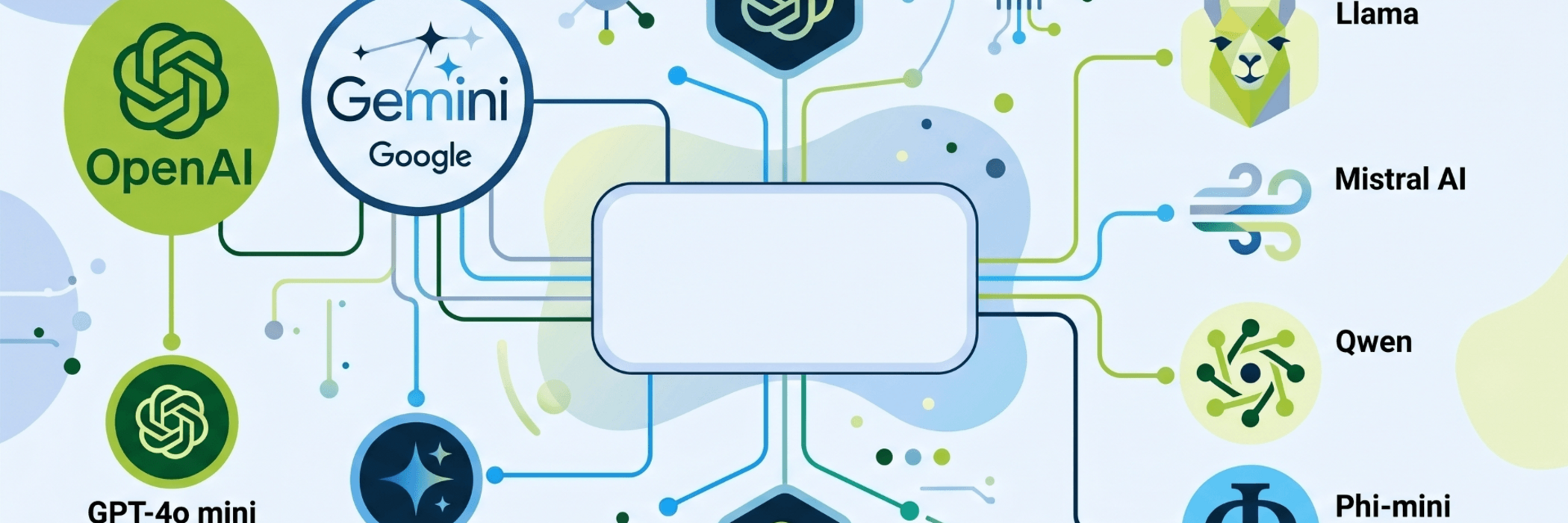
Yet whilst the giants in Silicon Valley are pouring billions into training systems capable of explaining quantum physics and designing complex software architectures, the real revolution is taking place behind the scenes: in the realm of Small Language Models (SLMs) and the ‘mini’ versions offered by the major providers. For developers and companies setting up chatbots, customer service automation or intelligent search systems (RAG – Retrieval-Augmented Generation), the motto increasingly applies: bigger is not necessarily better – but often simply more expensive and slower.
The paradox of AI search: why ‘world knowledge’ is often a hindrance
When an AI system searches a company’s internal documents or answers customer queries about a specific product, a crucial principle comes into play: context injection. The RAG principle: the system first retrieves the relevant information from a database and passes it, together with the question, to the language model as context.
At this point, the painstakingly trained “world knowledge” of a flagship model becomes largely irrelevant. The AI does not need to know by heart who discovered America in 1492 or how the theory of relativity works. It simply needs to:
- Understand the text provided without error.
- Derive the answer logically and precisely from this text.
- Strictly adhere to instructions (e.g. not to generate hallucinations).
- Output the result in a clean format (such as JSON for APIs).
Consequently, the smaller model variants are not only sufficient for these tasks, but are vastly superior to the giant models in terms of speed (latency) and cost-effectiveness (token costs).
A comparison of the players: from open source to closed source
The market for small, efficient models can be divided into three camps, each bringing specific strengths to the table.
1. OpenAI: The precision craftsmen (GPT-4o mini / GPT-5 class Mini & Nano)
OpenAI’s strategy for smaller models (such as the established GPT-4o mini and newer Nano iterations) focuses primarily on developer-friendliness and logical consistency.
- Strengths: Extremely strong at instruction following (adhering to system prompts) and structured output. If your chatbot needs to respond in exact JSON format to drive an API, these models perform at their best.
- Cost factor: Due to the AI price war of recent years, the costs for this class have shrunk to a fraction of what they were (often under $0.15 to $0.25 per million input tokens).
2. Google Gemini: The Context Kings (Gemini Flash & Flash-Lite)
With its Gemini Flash family (such as Gemini 2.0/2.5 Flash), Google has occupied a very specific sweet spot that is revolutionary for AI search: the huge context window.
- Strengths: Whilst small models used to be able to process only short texts, the Flash models offer up to 1 million tokens of context as standard. This means that when performing a search, you can provide the model with entire manuals, hundreds of customer service logs or huge code files directly in the prompt. Furthermore, they are natively multimodal (processing text, audio and video simultaneously).
- Cost factor: Google is taking an aggressive approach here, offering Flash models at extremely low prices or in generous free tiers.
3. Open Source / Open Weight: The guarantors of independence (Llama, Mistral & Qwen)
Those who do not wish to send their data via external APIs (keywords: GDPR and data sovereignty) should opt for open-source models. Models such as Meta’s Llama 3/4 (in the smaller 3B or 8B variants), Ministral (from Mistral AI) or Alibaba’s Qwen series are in no way inferior to commercial models.
- Strengths: Absolute control. These models can be run on-premises on your own hardware or in a private cloud. Thanks to modern quantisation techniques, models such as Llama 3.2 3B or Phi-4-mini even run on laptops or edge devices. They are also excellent for fine-tuning for specific tasks.
- Cost factor: No direct API costs per token, but costs are incurred for your own hosting infrastructure (GPUs).
The models in direct competition for chatbots & RAG
| Model family | Type | Primary strength | Ideal use case | Context window |
|---|---|---|---|---|
| OpenAI Mini/Nano | Proprietary (API) | Structured outputs, tool calling, extremely low latency | Complex chatbots with API integrations, routing of user queries | Medium (approx. 128K) |
| Gemini Flash / Lite | Proprietary (API) | Huge context, multimodality (audio/video), unbeatable price | RAG search across vast amounts of documents, analysis of audio support calls | Huge (1M+) |
| Llama (Small) / Mistral | Open source | Data sovereignty, customisability via fine-tuning | GDPR-critical customer chats, on-premise enterprise search | Medium to large (128K) |
| Qwen (Small) / Phi-mini | Open source | Powerful logic in a compact package (sub-4B parameters) | On-device applications (e.g. in cars or on smartphones) | Medium to large |
Conclusion: What does the optimal tech stack look like?
A multi-stage model (model routing) is increasingly becoming the norm for modern AI architectures. Instead of simply sending every query to the most expensive flagship model, the state-of-the-art approach looks like this:
- Reception (router): An ultra-small model (e.g. GPT Nano or Llama 3B) receives the user’s query and categorises it. Is it just small talk? A spam query? Or a genuine support query?
- The search (RAG): The database returns the relevant documents.
- Processing (the worker): A highly efficient model such as Gemini Flash or GPT-4o mini (or a locally hosted Llama/Mistral) reads the context and formulates the precise answer for the customer.
- The exception: Only if the router detects that highly complex, multi-level logical reasoning is required is the query escalated to the expensive ‘reasoning’ models (such as OpenAI’s o-series or Gemini Ultra).
Anyone building a chatbot today can save up to 90% on operating costs through the clever use of these ‘small’ models – without the end user noticing even the slightest drop in quality.