
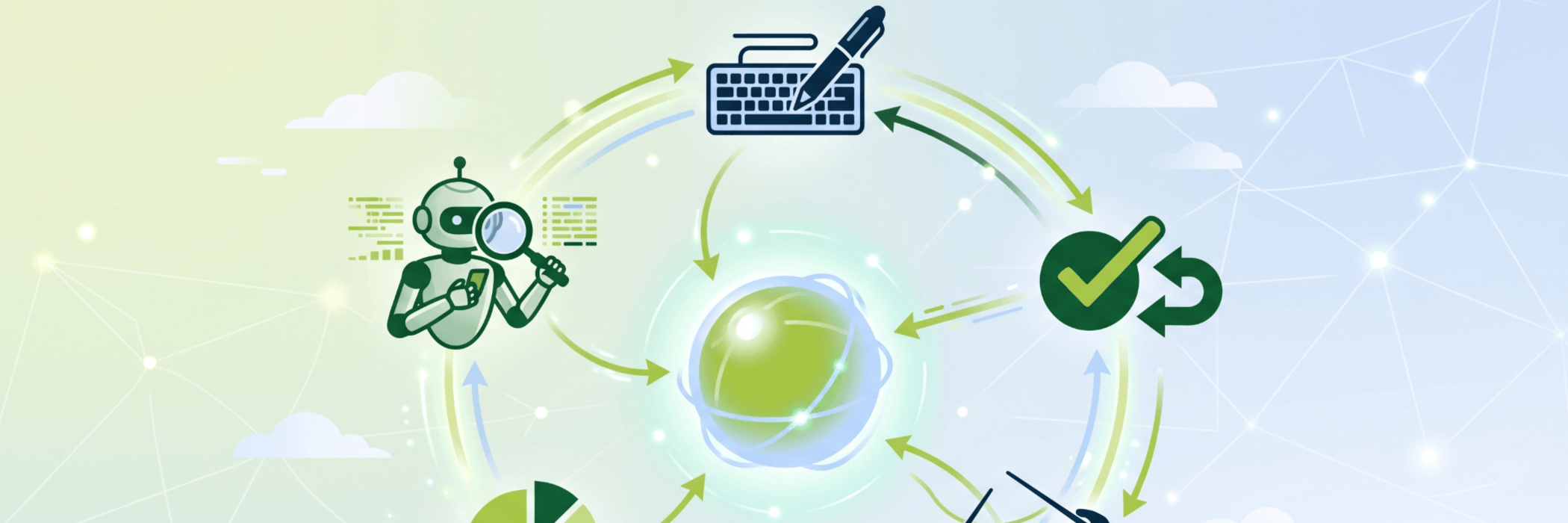
The solution? Multi-agent systems (MAS). Here, it is no longer a ‘jack-of-all-trades AI’ at work, but a team of specialised experts who discuss, negotiate and solve tasks together. Imagine it as a state-of-the-art editorial team, where every agent has a crystal-clear role – and our green ‘Open Claw’ lobster takes charge of coordination.
What exactly are multi-agent systems?
A multi-agent system is a network of several AI agents, each specialising in a specific sub-task. Instead of a single model attempting to research, write, fact-check and carry out SEO optimisations all at once, the workflow is divided up. What makes this special is the inter-agent communication. The agents ‘communicate’ with one another via APIs. They provide feedback, request corrections or negotiate the best outcome.
Anatomy of a workflow: From idea to finished content
Let’s take a practical example: the creation of a white paper. In a multi-agent setup, the ‘team’ looks like this:
- The researcher: Searches the web and internal databases for valid sources and data points.
- The Writer: Creates a first draft based on the research.
- The Critic (Editor): Analyses the draft for logical errors, tone and brand compliance. They return the text to the Writer with requests for corrections.
- The SEO specialist: Optimises the keywords and structure for search engines.
- The Manager (Orchestrator): Monitors the process and only approves the final document once all criteria have been met.
The ‘negotiation’ aspect
This is the most fascinating part. If the critic says, “This section is too vague,” the writer might reply, “I need more data from the researcher to make this more precise.” This iterative process (agentic loops) leads to a quality of results that a single AI could never achieve in a single pass (“zero-shot”).
The technical advantages: Why specialised agents are better
- Higher accuracy: The principle of ‘mutual control’ (self-reflection) drastically reduces hallucinations. One agent catches the other’s mistakes.
- Modular design: If your SEO strategy changes, you don’t have to rebuild the entire system. You simply swap out the “SEO agent” or update its instructions.
- Scalability: Multi-agent systems can autonomously handle complex, time-consuming tasks over hours or days, whilst a human merely approves the final milestones.
Challenges: When agents go round in circles
Despite the potential, there are technical hurdles:
- Agentic loops: Without clear termination criteria, two agents could argue endlessly over a single phrase.
- Token costs: A lot of communication means a lot of data. An efficient design is crucial to keeping costs under control.
- Orchestration: Controlling who is allowed to speak and when (much like a conductor) requires complex frameworks such as AutoGen, LangGraph or CrewAI.
Conclusion: The future belongs to the team
Multi-agent systems transform AI from a tool into a digital workforce. For businesses, this means: we no longer build chatbots, but design processes in which specialised AI units collaborate autonomously and goal-orientedly. Our “Open Claw” approach demonstrates that when the claws (the agents) interlock precisely, the result far exceeds the sum of its parts.
Are you ready to assemble your first digital team? The technology is ready – it all comes down to process design now.