
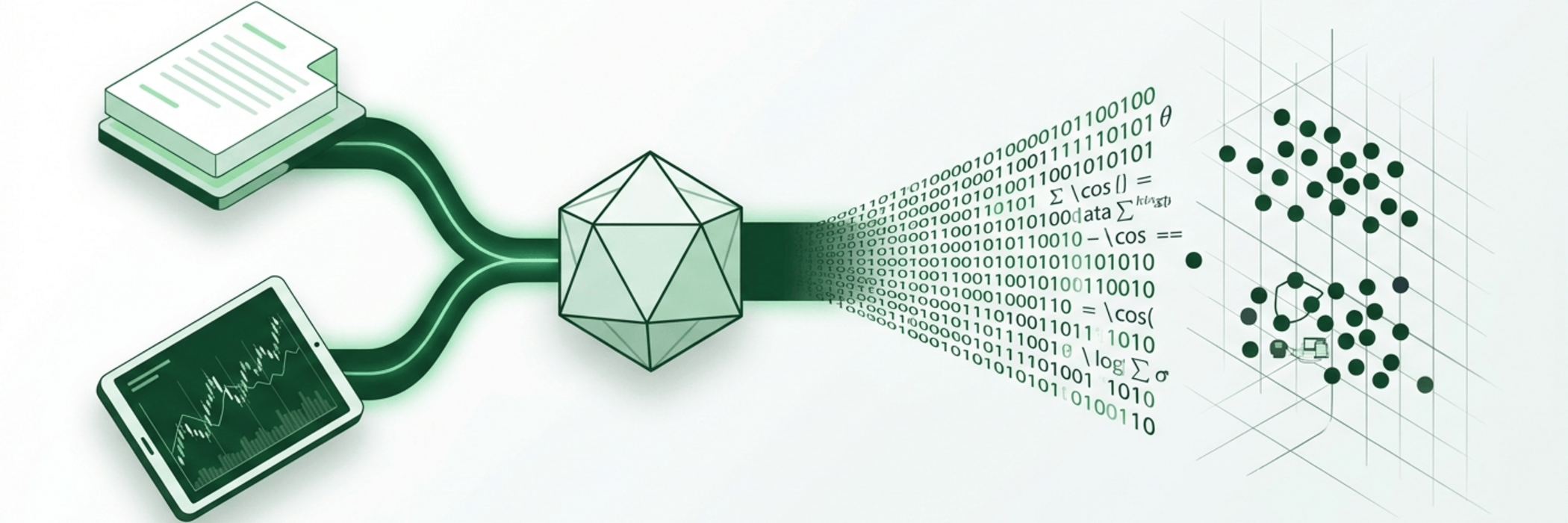
Yet even the most powerful generative AI remains blind if it is not fed the right information. The unassuming yet technologically crucial link for precise knowledge retrieval (Retrieval-Augmented Generation) is provided by so-called embedding LLMs. They translate unstructured data into a mathematical map.
1. The intuition: a map of meanings
To understand how an embedding works, an analogy from everyday life is helpful. Let’s suppose a librarian is tasked with finding relevant documents on the topic of ‘group collaboration’ in a disorganised archive. There are two options on the table:
Document A: “How ants work together to build complex colonies.”
Document B: “The chemical composition of elements in the 15th main group.”
A classic, algorithmic keyword search (such as the traditional Ctrl+F function) would primarily select Document B. The reason: here, the string “group” finds an exact, literal match – even though the document is about chemistry and completely misses the point.
However, any human reader would immediately recognise that Document A reflects the semantics being sought – the deeper meaning of cooperation and collective work – even though the word “group” or “cooperation” does not appear in the title at all.
2. The technical deep dive: vectors and distance metrics
From a technical perspective, embedding models are specialised encoder architectures or modified sub-layers of autoregressive transformers. Instead of generating new tokens sequentially, the model extracts the hidden state of the final neural layers. This is usually done via so-called mean pooling across all token representations. The result of this transformation is a dense vector – an array of floating-point numbers with a fixed dimensionality (typically d = 768, 1536 or 4096). A document or text segment T is mapped to a vector via the function f: T → v:
v = [v1, v2, v3, ..., vd] ∈ R^d
The semantic comparison of two entities is then performed using geometric distance measures in this vector space. The standard for retrieval is cosine similarity, which calculates the cosine of the angle between two vectors.
A key milestone in modern embedding methods is Matryoshka Representation Learning (MRL). This training methodology forces the model to concentrate the most critical semantic information in the leading dimensions of the vector. This allows a vector to be reduced from 4096 to, for example, 256 dimensions if required. The savings in storage space and computation time within the downstream vector database (e.g. Chroma) are massive, whilst the loss in retrieval accuracy remains marginal.
3. Comparison of architecture classes
In practice, system architects face a choice between different deployment models. This choice has a fundamental impact on latency, data privacy and operating costs.
- Proprietary APIs (e.g. OpenAI text-embedding-3, Cohere Embed v3)
- Advantages: Minimal integration effort, no need for proprietary GPU infrastructure. Excellent performance by default and native MRL support.
- Disadvantages: Outflow of sensitive corporate data (data outbound). Scaling costs difficult to calculate for massive data volumes. No deep weight adjustment (fine-tuning) possible.
- Open-source text embeddings (e.g. BGE-M3, Jina Embeddings v3)
- Advantages: Full data sovereignty through local deployment. Excellent multilingual support and support for long contexts (8k to 32k tokens). Targeted fine-tuning via triplet loss for proprietary technical terminology is possible.
- Disadvantages: Requires dedicated hosting and maintenance resources. Pure text models systematically fail as soon as documents contain complex tables, diagrams or scans.
4. The limits of multimodality: Qwen3-VL-Embedding-8B
Traditional RAG pipelines hit a hard limit as soon as the dataset originates from real-world business practice: PDF reports with nested layouts, balance sheets in tabular form, infographics or dashboards. Here, the traditional combination of optical character recognition (OCR) and pure text embedding often fails, as the structural arrangement of the information is lost.
With the launch of the Qwen3 family in spring 2026, Alibaba has fundamentally addressed this problem. The Qwen3-VL-Embedding-8B represents a new generation of native, multimodal embedding models (Vision-Language).
The model’s key technological features:
- Unified Semantic Space: Unlike older architectures such as CLIP, which require separate encoders for text and images to be aligned via contrastive alignment, Qwen3-VL utilises a deeply integrated architecture. Raw text, complex diagrams, scans and UI screenshots are projected directly into the same, congruent vector space.
- 32k-token context window: For a vision-based model, this context window is exceptionally large. It enables high-resolution processing of multi-page documents or sequential video frames without destructive pre-partitioning (chunking).
- Native Visual Document Retrieval (VDR): The model ‘sees’ the visual layout of a balance sheet. It captures the spatial relationship of table cells directly, eliminating the need for error-prone OCR intermediate steps.
Infrastructural implications
This enormous performance brings with it changed requirements for the IT infrastructure. With 8 billion parameters, the model is many times larger than classic BERT variants, which often operate with fewer than 512 million parameters. Local deployment requires dedicated VRAM (e.g. NVIDIA A10G or A100) as well as optimised inference frameworks such as vLLM or SGLang with FlashAttention-2 support enabled. Furthermore, the model requires precise task instructions during retrieval to process asymmetric queries (e.g. text-to-image) with maximum precision.
5. Strategic Conclusion for Enterprise Architecture
The decision on the right embedding model is strictly guided by the nature of the data matrix:
If the focus is on purely text-based representations – such as source code repositories, cleaned-up Markdown documents or structured database exports – lean text embeddings remain the most cost-effective choice due to minimal latencies and low compute costs.
However, as soon as the knowledge domain is defined by visual documents, scanned contracts, complex industrial diagrams or mixed media, there is no way around multimodal approaches. In this segment, the Qwen3-VL-Embedding-8B defines the current state of the art for privacy-compliant, locally operated enterprise pipelines.